


AI BILLBOARD ADS FREE Video Prompt
VIDEO Prompt
Get the images of your model and product and sign in to Google Flow , upload your images and write this prompt.
**VIDEO CONCEPT:** Photorealistic viral outdoor advertising stunt filmed entirely on an **orange iPhone 17 Pro Max**. Preserve the exact identity, appearance, outfit, and product references. Do not redesign, replace, or modify the product.
### SCENE 1 — BILLBOARD REVEAL | 0–2s
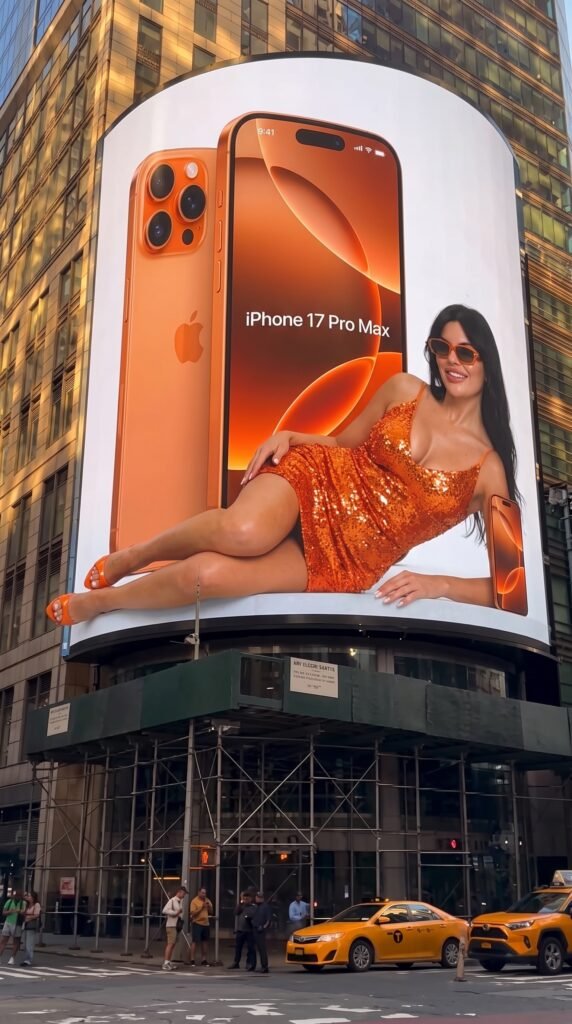
Film with a realistic **handheld orange iPhone 17 Pro Max** from street level in downtown Manhattan, New York City.
Show a massive premium advertising billboard mounted on the facade of a Manhattan building. The billboard structure has realistic surrounding scaffolding. The street below contains authentic New York activity: yellow taxis, pedestrians, vehicles, storefronts and natural urban movement.
The footage must look like genuine smartphone footage captured on an **orange iPhone 17 Pro Max**, including subtle natural handheld movement, realistic exposure, smartphone-level depth of field and slight motion response from the filmmaker.
The billboard displays the woman from **@Image 2** as a high-end advertising model.
She is shown **full-body from head to toe**, lying elegantly on her side and supported by one forearm. Her torso is slightly arched and her legs extend naturally toward the edge of the billboard. She has a confident, glamorous expression and maintains a polished luxury-advertising appearance.
Use the **exact outfit from @Image 3**. Do not alter the outfit, colors, materials, styling or design.
The billboard background contains a pale blue sky with soft clouds and a clean, minimalist luxury-advertising composition.
Place the product from **@Image 4** prominently in one corner of the billboard.
**IMPORTANT:** The product must be completely separate from the woman. It must never overlap her head, face, torso, arms, hands, legs, feet, shoes or clothing.
—
### SCENE 2 — BILLBOARD COMES TO LIFE | 2–4s
The printed woman on the billboard begins to come alive.
Create a seamless transition from a **flat 2D printed advertisement into a realistic three-dimensional human figure**, as though she physically emerges from the billboard while preserving the same appearance, outfit and facial identity.
She naturally shifts her weight while remaining supported by one arm, then smoothly moves into a seated position on the edge of the billboard.
She sits upright with her **legs crossed naturally**, one leg resting over the other.
Her top leg gently swings back and forth in a relaxed, playful manner.
She maintains direct eye contact with the iPhone camera throughout the movement and has a confident, playful smile.
Keep her **entire body visible whenever possible**, including her head, torso, legs, feet and shoes.
The product remains in its original billboard corner and stays completely visible and separate from her body.
—
### SCENE 3 — PRODUCT PICKUP AND THROW | 4–7s
The woman looks toward the product with a playful, confident expression.
She reaches naturally toward the product and picks it up from the billboard surface.
**CRITICAL CONTINUITY RULE:**
The precise area where the product was originally displayed must become **completely empty immediately after she picks it up**.
The billboard surface underneath must be clean and natural, matching the surrounding billboard background exactly, as if the physical product has actually been removed.
There must be **no duplicate product, ghost image, printed product, shadow artifact or replacement object** remaining in that location.
The product is now entirely in the woman’s hand and physically exists outside the billboard graphic.
As she holds it, the product transitions from its billboard representation into a **fully three-dimensional physical object**, while maintaining the exact visual identity of **@Image 4**.
She then smoothly winds up and throws the product directly toward the camera.
Maintain playful, confident eye contact and a subtle teasing smile.
During flight, the product may rotate naturally, but keep its **logo and important branding facing the camera whenever physically possible** and clearly readable.
—
### PRODUCT FIDELITY — ABSOLUTE PRIORITY
The product must remain visually identical to **@Image 4**.
Preserve:
* Exact shape
* Exact proportions
* Exact colors
* Exact materials
* Exact surface finish
* Exact logo
* Exact text
* Exact branding
* Exact packaging/design details
Do **not** redesign, reinterpret, simplify, stylize or replace the product.
Do not allow:
* Warping
* Melting
* Stretching
* Morphing
* Deformation
* Unwanted color changes
* Logo changes
* Text changes
* Branding changes
* Packaging changes
* Duplicate products
The product must behave like a real physical object obeying realistic gravity and momentum.
—
### SCENE 4 — CAMERA CATCH | 7–9s
As the product rapidly approaches the camera, the person filming reacts naturally.
The **orange iPhone 17 Pro Max** jolts slightly backward and sideways, creating an authentic handheld reaction.
A realistic female hand enters the frame from below the camera and catches the product.
The hand brings the product close to the iPhone 17 Pro Max lens.
The product fills a significant portion of the foreground while its logo, text and branding remain **sharp, recognizable and readable**.
Maintain subtle natural handheld camera movement.
In the background, the original billboard remains visible.
The woman is still seated on the billboard edge with her legs crossed. Her top leg continues gently swinging while she smiles and maintains eye contact with the camera.
The original product location on the billboard remains **completely empty**.
—
### SCENE 5 — FINAL PRODUCT HERO SHOT | 9–10s
The filmmaker’s hand holds the product steadily close to the **orange iPhone 17 Pro Max** lens.
Create a premium final product moment with realistic smartphone focus behavior.
The product’s logo, text and branding remain crisp and clearly readable.
The billboard remains visible in the background, with the woman still seated on its edge.
She remains relaxed and smiling, maintaining direct eye contact with the camera while her crossed top leg gently swings.
The exact location where the product originally appeared on the billboard remains completely empty.
End on a strong, visually striking product-and-billboard composition.
—
### CAMERA & ENVIRONMENT
**Camera:** Orange iPhone 17 Pro Max
**Capture style:** Authentic handheld smartphone footage
**Environment:** Downtown Manhattan, New York City
**Lighting:** Warm golden-hour natural sunlight
**Look:** Photorealistic, cinematic but believable
**Movement:** Natural handheld camera shake and subtle smartphone stabilization
**Focus:** Realistic smartphone autofocus and occasional brief soft focus during rapid movement
**Physics:** Realistic human movement, gravity, momentum and object interaction
**Atmosphere:** Authentic New York urban environment with pedestrians, taxis, scaffolding and natural street activity
The footage should feel like an unexpected viral moment captured by a person standing on a New York street—not like a conventional CGI commercial.
### HARD CONTINUITY RULES
1. The woman must remain recognizable and visually consistent throughout the entire video.
2. Preserve the exact outfit from **@Image 3**.
3. Keep the woman’s body fully visible whenever framing allows.
4. Keep her head, face, torso, legs, feet and shoes visible.
5. The woman must maintain eye contact with the camera during her interaction.
6. Her seated pose must have naturally crossed legs.
7. Her upper crossed leg must gently swing throughout the later scenes.
8. The product must never overlap or obscure the woman’s body or clothing.
9. The product must remain identical to **@Image 4**.
10. The product must never deform, warp, melt, morph or change appearance.
11. After the woman picks up the product, the original billboard product location must remain permanently empty.
12. Never leave a duplicate printed version of the product behind.
13. Never create a second product.
14. Maintain realistic hand-to-product interaction.
15. Maintain realistic throwing and catching physics.
16. Keep the product’s branding facing the camera as much as naturally possible during flight.
17. No additional people interacting with the billboard.
18. No subtitles.
19. No captions.
20. No added on-screen text.
21. No artificial graphics or UI elements.
22. No music.
23. Audio consists only of realistic New York environmental ambience and subtle ASMR-style physical sounds.
24. Maintain the authentic **orange iPhone 17 Pro Max handheld filming aesthetic** throughout.
25. Do not redesign or modify the product under any circumstance.
**OVERALL STYLE:** Photorealistic viral luxury advertising stunt, cinematic realism, premium fashion campaign quality, authentic New York City atmosphere, realistic human motion, realistic object physics, natural smartphone cinematography, believable practical interaction between billboard, woman and product.
PRO Tips
1. Use high-quality reference images
Start with clear product and character images. Better references generally give the AI model more visual information to work with.
2. Keep the product reference consistent
Use the same product reference throughout the prompt. Clearly state that the AI should preserve the product’s shape, proportions, colors, materials, logo, packaging, and branding.
3. Keep the video short
For this particular concept, a 10-second video is recommended because the prompt is structured around a short sequence of billboard reveal, transformation, product interaction, and final product shot.
4. Make the environment believable
Add realistic environmental details such as pedestrians, vehicles, buildings, natural lighting, camera movement, and surrounding activity. These details can help sell the illusion that the billboard stunt is happening in the real world.
5. Give the AI clear continuity instructions
If the product moves from the billboard into the woman’s hand, explicitly describe what should happen to the original product location. This prompt, for example, instructs the model to leave the original billboard position empty after the product is picked up.
6. Control the camera movement
Specify the camera style instead of simply asking for a “cinematic video.” For example, this prompt uses handheld smartphone footage, natural camera shake, autofocus behavior, and realistic exposure changes to create a believable social-media-style recording.
7. Create the hook immediately
The billboard should capture attention in the first few seconds. A surprising transformation—such as a person appearing to step out of a billboard—can create a strong visual hook before the product interaction.
8. Design the final frame around the product
The final shot should clearly show the product and its branding. This gives the video a recognizable advertising payoff instead of ending immediately after the visual stunt.
NOTE:
- 10 seconds video give best result.
- Watch video below if you are unable to make video yourself.
Common Mistakes
1. Using low-quality product images
A blurry or poorly lit product reference can make it harder for the AI model to reproduce packaging and branding accurately.
2. Changing the product reference halfway through
Using different product images or inconsistent descriptions can cause the product to change appearance between scenes.
3. Not specifying product continuity
If you don’t explain what happens when the product moves, AI video models may create duplicate products, leave a second product on the billboard, or generate visual artifacts.
4. Making the prompt too vague
“Create a viral billboard ad” does not provide enough information about the camera, environment, character, product, movements, timing, or transitions. Detailed scene instructions can provide much stronger control.
5. Trying to put too many actions into one short scene
Complex actions such as walking, picking up a product, throwing it, catching it, and changing camera angles can become difficult for an AI model to execute accurately. Breaking the concept into clearly defined scenes can help.
6. Ignoring human-product interaction
Hands interacting with products are often challenging in AI-generated video. Describe how the character reaches for, holds, throws, or interacts with the product rather than leaving the interaction ambiguous.
7. Forgetting branding requirements
AI can sometimes modify logos, packaging text, colors, or product shapes. Explicitly instruct the model to preserve the product’s branding and design.
8. Adding unnecessary text
For a realistic viral billboard stunt, excessive captions, subtitles, UI elements, or artificial graphics can reduce the realism of the footage. This prompt specifically excludes added subtitles, captions, and on-screen text.
9. Focusing only on visual effects
A spectacular AI effect is useful for grabbing attention, but the product still needs to be clearly presented. Make sure the video eventually brings attention back to the product and its branding.
Summary
An AI BILLBOARD ADS FREE Video Prompt can turn a simple product image and character reference into a cinematic billboard advertising concept. Using Google Flow, you can create a sequence where a woman appears on a large outdoor billboard, comes to life, interacts with the product, throws it toward the camera, and ends with a close-up product hero shot.
For better results, focus on high-quality reference images, product consistency, realistic camera movement, clear scene instructions, believable physics, and strong product visibility. Avoid common AI video problems such as duplicated products, distorted packaging, inconsistent characters, and overly complicated actions.
This type of AI advertising concept can be adapted for ecommerce brands, beauty products, fashion, jewelry, consumer products, and other visual products that benefit from attention-grabbing short-form advertising.
Related AI Ads Prompts
Step by Step Viral Ad Creation Tutorial using Google Flow
- Clay Sculpting AI Video ads using Google Flow Free Prompt
- Almond shell carving video Free Prompt
- Wooden Build Transformation Video Free prompt
- Object Assembly Animation
- Independence Day Light Viral Shot Free Prompt
- Micro Vehicle Unboxing Video Free Prompt
- Hair to waterfall Free Prompt
- Tsunami Miniature Behind the scenes Free Prompt
- Crystal Ball Reveal Video Free Prompt
- Action Figure Assembly 14 August Video Free Prompt
- Creature to Jewelry Transformation Video Prompt
- Giant Animal Movie BTS Free Video Prompt
- Time Freeze Viral Video Prompt
- AI Billboard Ads Video Prompt
- Rolls Royce Car Instagram Trend Video Prompt
- Viral Earring Trend Free Video Prompt
Find quick answers to the most common questions about AI BillBoard Ads. Discover how this simple editing step can instantly make your content more engaging, professional, and ready to grab attention in 2026.
AI billboard ads turn your product into a visually surprising advertising experience—for example, a model appearing to step out of a billboard, interact with your product, or bring it into the real world.
For ecommerce brands, this type of creative can help you grab attention quickly, demonstrate your product in an unexpected way, and create content that is highly shareable on platforms like TikTok, Instagram Reels, and YouTube Shorts.
Yes. I can create AI-powered product ads designed around strong visual hooks, storytelling, product interaction, and unexpected scenes rather than simply placing your product into a generic AI video.
The goal is to make viewers stop scrolling, become curious about what is happening, and ultimately pay attention to your product.
No ad can guarantee virality, but the creative can be deliberately designed around elements that make short-form ads more attention-grabbing and shareable.
Can you create an AI billboard ad using my exact product?Not necessarily. In many cases, a high-quality product image can be enough to start creating an AI advertising concept.
I can use your existing product images and transform them into cinematic scenes, UGC-style concepts, storytelling ads, product demonstrations, CGI-style advertisements, and other creative formats without requiring a traditional photoshoot for every concept.
Can you create an AI billboard ad using my exact product?
Yes. Your product can be used as the visual reference so the generated ad is built around your actual product.
I focus on maintaining important product details such as packaging, shape, colors, materials, branding, and overall appearance throughout the creative.
Can AI ads make my brand look premium?
Yes. AI video can be directed toward different visual styles depending on your brand.
For example, a beauty brand could use luxury cinematic visuals, premium product photography, lifestyle scenes, dramatic storytelling, or high-end CGI-inspired advertising instead of generic AI footage.
The creative direction should match your brand positioning rather than simply using an AI effect because it looks impressive.
Can you create different versions of the same ad?
Yes. This is one of the biggest advantages of using AI for advertising.
Instead of producing only one creative, I can develop multiple hooks, scenes, storylines, product interactions, visual styles, and CTAs from the same product.
This gives a brand more creative variations to test across platforms instead of relying on one advertisement.
Can you create ads for TikTok, Instagram Reels, and YouTube Shorts?
Yes. AI ads can be created specifically for vertical short-form platforms, with the composition, pacing, hook, camera movement, and storytelling designed for mobile viewing.
The same product can also be adapted into different creative concepts for different platforms.
Can you create an AI ad if I only have one product photo?
Yes. One strong product image can become the starting point for an entire advertising concept.
For example, a single product image can be transformed into:
- A cinematic product commercial
- An AI billboard stunt
- A luxury lifestyle advertisement
- A product problem-to-solution story
- A UGC-style advertisement
- A dramatic storytelling ad
- A CGI-style product commercial
- A social-media hook ad
This allows brands to get significantly more creative possibilities from their existing product assets.
Can you create ads that tell a story instead of just showing my product?
Can you create multiple ad concepts for my product?Yes. Storytelling can be built around the problem → emotion → product → transformation → CTA structure.
For example, instead of simply showing a skincare product, an ad could begin with a relatable skincare problem, introduce the product as the solution, visually demonstrate the transformation, and finish with a clear reason to take action.
Can you create multiple ad concepts for my product?
Yes. I can develop multiple creative angles around the same product so your brand isn’t dependent on one concept.
Possible angles include pain-point ads, UGC ads, storytelling ads, luxury ads, before-and-after concepts, educational ads, product demonstrations, founder stories, customer scenarios, CGI ads, and attention-grabbing visual stunts.
Will AI ads work for my beauty or ecommerce brand?
AI advertising can be used for many ecommerce categories, including skincare, makeup, haircare, perfume, jewelry, fashion, wellness, food, and consumer products.
The important part is matching the creative concept to the product, audience, brand positioning, and advertising objective.
Can you create ads that are made specifically to stop the scroll?
Yes. I can build the first few seconds around a strong visual or storytelling hook.
For example:
“What if your product could come out of a billboard?”
The objective is to create immediate curiosity before revealing the product and moving into the advertising message.
How is an AI ad different from a normal product video?
A traditional product video often requires models, locations, cameras, lighting, props, production teams, and post-production.
AI advertising can create many of those visual environments digitally, allowing brands to experiment with concepts that would otherwise require expensive or complicated production.
That doesn’t mean every AI ad will outperform traditional production. The advantage is the ability to test more creative ideas and produce unusual visual concepts efficiently.
Can you create an ad around my brand's existing marketing message?
Yes. I can take your existing product benefits, target audience, brand positioning, offer, and CTA and turn them into an AI-powered visual advertising concept.
This means the creative isn’t just visually impressive—it can be structured around the marketing message your business actually wants customers to remember.
Why should I use AI ads instead of creating just one traditional advertisement?
One of the biggest benefits is creative testing.
Instead of putting all your budget and effort into one concept, AI can make it easier to explore multiple creative directions and identify which hooks, stories, and visual approaches deserve further testing.
For brands dealing with creative fatigue, this can provide a larger pool of advertising concepts to work with.
Can you create a complete AI advertising campaign for my product?
Yes. Rather than creating only one video, I can help develop a series of AI advertising creatives around the same product.
The campaign can include different hooks, storytelling angles, product-focused videos, UGC-style concepts, lifestyle scenes, and platform-specific variations.
This gives your brand a library of creative assets that can be tested and reused across your marketing campaigns.
How do I get an AI viral ad created for my brand?
You can provide your product images, website/product information, target audience, and advertising goal. From there, I can develop the creative concept, visual direction, AI-generated scenes, and final short-form video.
The process is designed to turn your existing product assets into attention-grabbing AI advertising creatives without requiring a traditional production setup for every concept.