


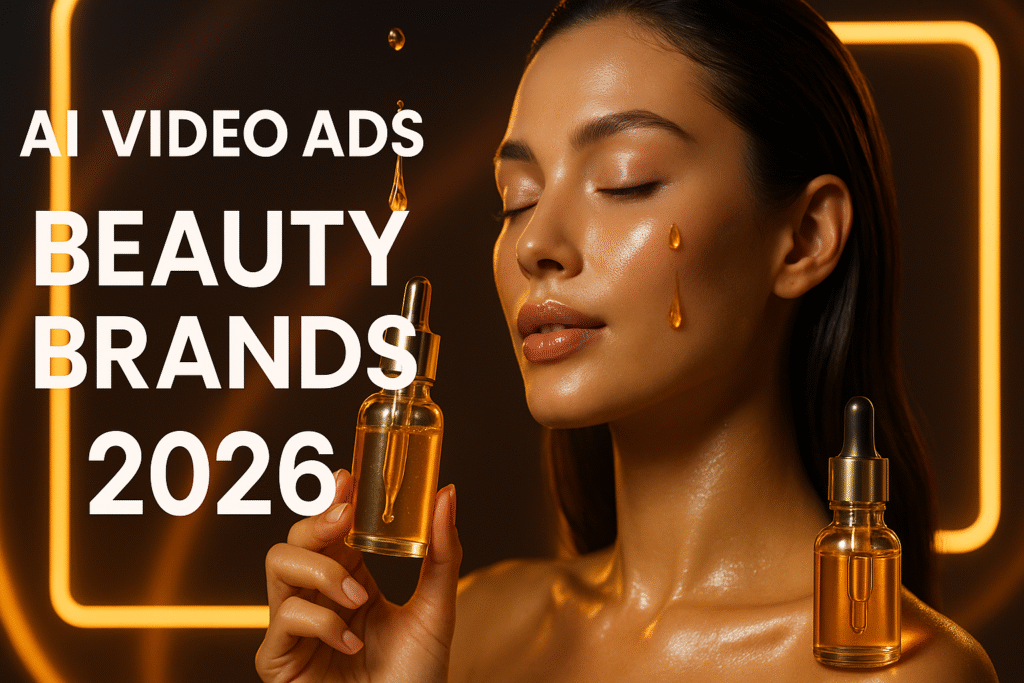
The beauty industry has always been visual, emotional, and fast-moving. But in 2026, something bigger changed. AI video ads became the leading force driving conversions, creativity, and culture.
Consumers now expect:
Flawless visuals
Dynamic storytelling
Personalized experiences
Fast-paced edits optimized for TikTok, Reels, and Shorts
AI tools now meet these expectations better than human-only workflows.
Beauty brands from skincare startups to global makeup giants are producing:
CGI cream textures
Slow-motion serum shots
AI-generated skin transformations
Before/after sequences
Luxury cinematic commercials
And they’re doing it faster, cheaper, and more consistently than ever before.
This is the era of AI Video Ads for Beauty Brands in 2026.
AI video ads are not just a trend. They are a structural transformation in how beauty brands create, test, and scale campaigns.
The 5 Core Shifts Revealed
Studio-Quality CGI Without a Studio
Tools like Google Veo 3 and Pixverse produce hyper-real cosmetics shots that look like $50,000 commercial footage.Instant Human Spokespersons
With Higgsfield and NanoBanana, brands create spokesmodels that deliver flawless performances — no reshoots, no scheduling.Ultra-Real UGC Videos Using AI Humans
Grok provides narrative consistency, letting brands produce TikTok-style user reviews using believable actors.Voiceovers That Sound Studio-Recorded
ElevenLabs voices mimic natural emotion, perfect for beauty tutorials, testimonials, and founder story videos.Costs Drop by 70%–90%
This is where AI becomes unbeatable.
A CGI beauty ad made with Blender? $1500+
With AI? $300–$500 with better visuals.
The beauty category benefits more than any other niche — because beauty requires perfect visuals, and AI excels at perfect visuals.
They judge an ad in 0.3 seconds long before the message, script, or offer even registers. In that split moment, the viewer’s brain scans for micro-details that signal beauty, quality, and trust. Their eyes instantly evaluate skin to see whether it looks healthy, smooth, and natural. They notice texture, searching for realism instead of overly filtered or artificial surfaces. Clarity becomes a subconscious indicator of confidence and purity, especially for beauty ads where every pixel matters. Then comes lighting, which determines whether the product and model feel premium or low-budget. The colors in the frame also trigger emotional reactions, guiding the viewer toward calmness, excitement, or luxury depending on the palette. Symmetry shapes their sense of harmony and attractiveness, influencing how professional and aesthetically balanced the ad appears. Finally, the human brain reacts to motion, assessing whether movements feel cinematic, fluid, and intentional or awkward and distracting. All of this happens almost instantly, proving that beauty brands must design every ad with extreme attention to visual detail if they want to win those 0.3 seconds and convert the scroll into a sale.
Beauty brands gain 3 unique advantages
Flawless skin rendering (no expensive retouching)
Hyper-smooth transitions and slow-motion for creams/serums
CGI without needing props or product photography
This combination increases CTR, watch time, and conversions dramatically.
That’s why the keyword AI Video Ads for Beauty Brands in 2026 is exploding in demand across the industry.
The advertising landscape is changing faster in 2026 than in the previous five years combined. AI video ads for Beauty Brands in 2026 are no longer “experimental” They are the global standard for profitable marketing.
Marketers now create 20–200 ad variations in a day, test them instantly, and scale only the winning angles. Studio shoots, human actors, and long editing cycles are rapidly becoming optional.
This transformation is driven by new expert-level AI tools, including:
Google VEO 3: cinematic 4K–8K videos
Pixverse: motion, transitions, camera effects
Higgsfield: ultra-realistic AI humans
ElevenLabs: emotionally accurate voiceovers
Grok: research, hooks, angles, insights
NanoBanana: viral TikTok/Reels editing
The hidden truth is simple:
Brands using AI video ads for eCommerce 2026 will outperform brands that don’t.
Let’s reveal why??????????????????
Social platforms reward content that keeps users engaged. AI-generated visuals—smooth motion, perfect lighting, expressive faces—automatically outperform average human-shot footage.
Retention is higher.
CTR is higher.
CPM is lower.
Conversions are stronger.
This is why platforms silently boost AI content.
AI video ads for eCommerce 2026 align perfectly with platform algorithm behavior:
Dynamic movement
High visual density
Perfect lighting and composition
Fast-pacing
High emotional clarity
Strong storytelling
A brand using traditional camera shoots competes with a brand using AI-generated cinematic motion…
The winner is obvious.
| AI Tool | What It Does | Ideal For Beauty Brands |
|---|---|---|
| Google Veo 3 | Cinematic, hyper-real video generation | CGI textures, ingredient close-ups |
| Pixverse | Animation + AI visual storytelling | Smooth transformations, hair/skin sequences |
| Higgsfield | AI humans & expressive avatars | Spokesperson videos, tutorials |
| Grok | Script intelligence + storytelling | Smart ad scripts, UGC narratives |
| ElevenLabs | Ultra-real voiceovers | Tutorials, product explanation |
| NanoBanana | AI motion + UGC edits | Fast TikTok/Reels beauty edits |
These tools collectively power modern AI Video Ads for Beauty Brands in 2026.
AI is cheaper, faster, and consistently better for beauty brands. Here’s what the cost difference looks like:
Budget Comparison Table
| Task | Traditional Agency | Freelancer | AI Tools (2026) | Savings |
|---|---|---|---|---|
| CGI beauty ad (Blender) | $1,500–$3,000 | $700–$1,200 | $300–$500 | 70%–85% |
| Spokesperson video | $800–$2,500 | $300–$900 | $50–$200 | 80% |
| Texture/serum animation | $600–$1,200 | $200–$400 | $20–$80 | 90% |
| Voiceover recording | $150–$500 | $80–$200 | $5–$25 | 95% |
| Editing | $400–$1,000 | $150–$400 | $10–$40 | 90% |
This is why AI Video Ads for Beauty Brands in 2026 are so cost-effective — AI tools scale without increasing budget.
In 2026, the most successful beauty brands aren’t simply creating content — they’re operating with a precise, behind-the-scenes system used by elite marketers, agency insiders, and AI-powered creators. This hidden expert workflow allows brands to produce studio-quality visuals, celebrity-level spokesperson videos, and luxurious product shots at a fraction of the traditional cost. Instead of relying on massive production teams, complex lighting setups, or expensive CGI artists, beauty brands are quietly leveraging AI automation, smart asset pipelines, and rapid creative iteration to outpace their competitors. The result? Faster content cycles, constant ad testing, and a consistent visual identity that feels premium, modern, and emotionally resonant. In 2026, this workflow isn’t just an advantage — it’s the backbone of every beauty brand scaling profitably in a hyper-competitive landscape. If you understand and apply it, you operate like the top 1% of marketers who dominate feeds, capture attention instantly, and convert viewers into loyal customers with precision and style.
This is the exact workflow top DTC beauty brands use:
1. Use Grok for script & narrative
Tell Grok the emotion, problem, and ad duration.
2. Generate visuals with Google Veo 3
Use:
ultra close-ups
creamy textures
liquid pours
glowing skin shots
3. Use Pixverse for the transformation sequences
Perfect for:
before/after
skin clarity changes
hair shine boosts
4. Add a spokesperson using Higgsfield
Choose:
tone
personality
look
ethnicity
age
5. Generate voice with ElevenLabs
Choose:
seductive
soft
warm
expert
clinical dermatologist-style
6. Add TikTok-style edits using NanoBanana
Fast cuts + beauty transitions.
This workflow makes AI Video Ads for Beauty Brands in 2026 unbeatable.
Use soft lighting prompts for skin-focused shots.
Always include “cosmetic-grade realism” in prompts.
Add slow-motion shots for serums and creams.
Use 60–120 FPS effects in editing for luxury feel.
Generate multiple spokesperson versions and A/B test.
Use warm color palettes for skincare, bold for makeup.
Use text overlays with authority-based claims.
Include micro-transitions between scenes.
Use emotional storytelling + transformation.
Keep videos under 22 seconds for best CTR.
Over-polished skin that looks unrealistic
Not matching lighting styles between scenes
Mixing UGC style with cinematic without consistency
Using flat voiceovers
Using too many ingredients shots
Text that overlaps with product visuals
Ignoring pacing
Lack of clear CTA
Overuse of filters
Not optimizing for vertical video formats
AI Video Ads for Beauty Brands in 2026 are no longer optional. They’re the new competitive advantage. Beauty brands using AI tools will dominate with creativity, speed, and cost efficiency.
In 2026, the brands that win will be the ones that adapt fast and AI is the fastest lever you can pull. By embracing AI video ads for beauty brands in 2026, you gain the power to produce high-quality visuals, CGI-style shots, spokesperson videos, and product demos without the massive overhead of traditional production. AI doesn’t just save money, it removes limitations, letting you test more creatives, iterate faster, and reach your audience with personalized, scroll-stopping videos that feel handcrafted. Whether you’re a beauty founder, a marketer, or a creator, leveraging AI tools today positions you ahead of the competition tomorrow. The brands that thrive in 2026 will be those who adopted AI early. Starting now gives you everything you need to scale smarter, not harder.
Ready to start creating viral, high-converting AI video ads for your brand? Join my AI Video Ads Mastery Course and learn how to create cinematic ads in minutes: no studio, no actors, no editing skills needed.
 Enroll now and transform the way you market in 2026.
Find quick answers to the most common questions about AI Video ads for beauty brands in 2026 and discover how this simple editing step can instantly make your content more engaging, professional, and ready to grab attention in 2026.
They are AI-generated ads designed specifically for skincare, cosmetics, and haircare brands using tools like Google Veo 3, Pixverse, and Higgsfield etc.
Yes — the tools produce near-photorealistic beauty shots with perfect textures and lighting.
How much do AI beauty ads cost?
$100–$1000 depending on complexity.
Which tools are best for AI Video Ads for Beauty Brands in 2026?
Yes. Use voices and faces you have rights to. If you simulate a public figure or a real person’s likeness, you may need consent or risk legal issues. Maintain documentation and prefer non-identifiable synthetic presenters unless consent is explicit.
Can AI replace agencies for beauty brands?
Yes, for most ads, AI is 70–90% cheaper and faster.
Can AI ads perform as well as traditional ads?
Yes, in most cases, AI ads outperform traditional ads because they are faster to produce, easier to test, more customizable, and significantly more affordable. Brands can run multiple versions and optimize quickly.
Are AI voices realistic enough for ads?
Absolutely. Tools like ElevenLabs and Play.ht offer hyper-realistic voices with emotion, pacing, and tone control. They sound nearly identical to professional human voice actors.
Can I create consistent characters across multiple videos?
Yes. Tools like Runway Gen-3, PixVerse, and ChatGPT image-based prompting allow you to maintain a consistent character style, outfit, and facial features across an entire campaign.
How long does it take to create an AI video ad for Beauty Brands in 2026?
Most AI ads take 30 minutes to 3 hours depending on complexity.
Compare this to freelancers who take 3–7 days or agencies who take 2–4 weeks.
Are AI ads suitable for Beauty brands?
Yes, AI ads are perfect for Beauty Brands because they allow you to:
Test 10–20 variations quickly
Produce product demos and UGC-style videos
Create cinematic CGI visuals without expensive studios
Keep costs low while scaling testing budgets
Do I need powerful hardware or a fast computer?
No. Almost all AI video tools run in the cloud, meaning they don’t rely on your computer’s GPU or processing power. Even a basic laptop can create cinematic ads.
Can Beauty AI ads be used for TikTok, Reels, Shorts, and YouTube?
Yes. Tools like CapCut and Runway provide export formats for 9:16, 1:1, 16:9, and more. You can create one ad and instantly adapt it for multiple platforms.
Is it legal to use AI-generated content in Beauty Product ads?
Yes, as long as you use properly licensed tools. AI platforms typically grant commercial rights, meaning you can use the content in ads, campaigns, and brand promotions.
Can AI Beauty ads replace agencies entirely?
Not always — but they reduce 90% of the cost and complexity, making agencies optional instead of necessary.
Most brands now use a hybrid approach:
AI for core content
Agencies/freelancers only for advanced or large-scale projects
What type of ad performs best for Beauty Brands using AI tools?
AI works exceptionally well for:
UGC-style ads
CGI product showcases
Story-driven ads
Founder message videos
Demonstration or tutorial-style videos
Before/after transformations
Emotional storytelling ads
What’s the biggest advantage of using AI for ads?
The biggest advantage is speed + cost reduction + unlimited creativity.
You can produce premium-quality ads at 10–20% of traditional costs while testing multiple variations instantly.