



Day 17 unlocked the world of stickers, emojis, and expressive overlays; the emotional layer that increases retention and boosts engagement. But even the best-placed stickers lose their magic if your exported video looks soft, blocky, or washed out.
Today we’re expanding that foundation. Your visuals, timing, stickers, and animations deserve to be displayed with maximum clarity. Correct export settings ensure that everything you created — transitions, texts, overlays, color grading, motion tracking — remains sharp and beautifully preserved.
Great editing gets you 50 percent of the way.
Export mastery gets you the other 50.
Let’s unlock it.
You spent hours cutting clips, color grading, adding transitions, and syncing music — only to watch your finished video come out blurry, washed out, or choppy after export.
Sound familiar?
Most creators lose up to 40% of their video quality at the export stage. Not because they edited poorly — because they used the wrong settings when clicking that final “Export” button.
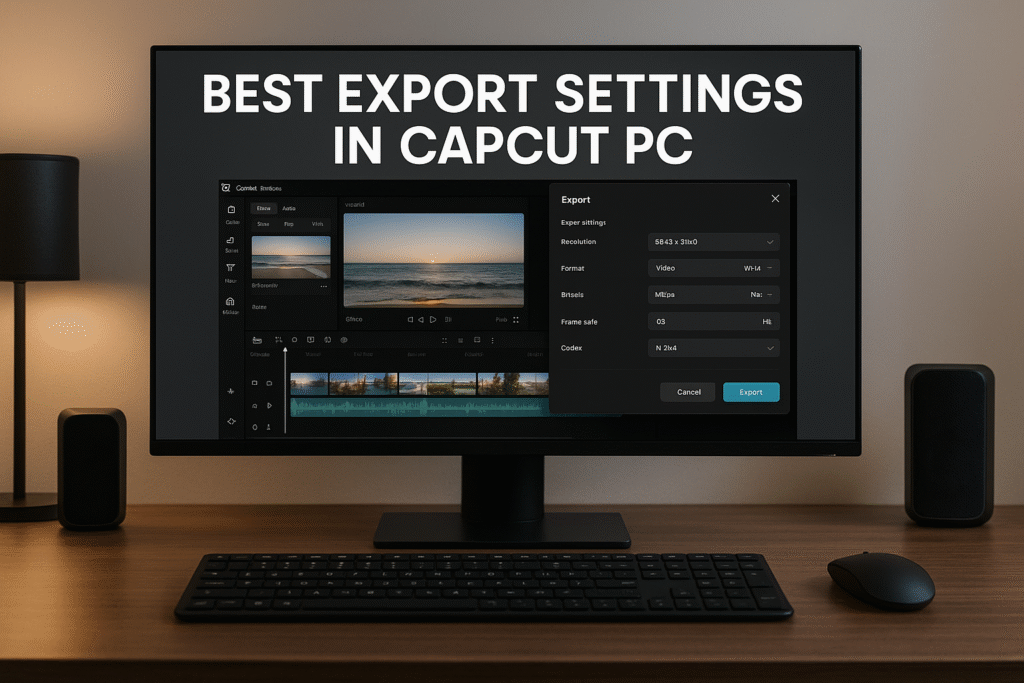
The best export settings in CapCut PC are the difference between a video that looks professional and one that looks like it was recorded on a potato. This guide breaks down every setting you need to know in plain English: resolution, bitrate, frame rate, codec, audio, and platform-specific configurations — including dedicated sections for YouTube Shorts and long-form YouTube videos.
Whether you’re a beginner or a seasoned creator, this is the only export settings guide you’ll ever need.
When you finish editing in CapCut PC and hit “Export,” the software takes your raw project timeline and renders it into a single video file. Export settings tell CapCut how to compress and package that file.
Every setting you choose at this stage directly impacts:
- Sharpness — How detailed your visuals appear
- Color accuracy — Whether your color grade survives compression
- Motion smoothness — Whether action sequences look fluid or choppy
- File size — How large the final file is on your drive
- Platform performance — How well your video survives re-compression by YouTube, TikTok, or Instagram
Here’s the core truth: social media platforms always re-compress your video after upload. Your job is to export at the highest quality before that happens, so what survives compression still looks great.
The best export settings in CapCut PC give your video the best possible starting point before the platform takes a swing at it.
Before diving into the best settings, you need to understand the options CapCut gives you. Here’s a breakdown in simple, actionable terms:
1. Resolution
This determines the number of pixels in your video.
1080p (Full HD)
Best for TikTok, Reels, Shorts, moderate-quality YouTube uploads.1440p (2K)
Higher clarity than 1080p, looks premium.2160p (4K)
Best for YouTube, cinematic footage, commercials, and client work.4320p (8K)
Not recommended unless needed — huge files and unnecessary for social media.
Resolution = sharpness + detail.
2. Frame Rate (FPS)
Frames per second determine the smoothness of motion.
24 FPS → cinematic films
30 FPS → YouTube / tutorials / vlogs
60 FPS → gaming, fast action, TikTok/Reels clarity
120 FPS → rarely needed unless doing slow-motion work
Always match your export FPS to your project FPS unless you want jitter or motion artifacts.
3. Bitrate
This is the BIGGEST quality factor after resolution.
Higher bitrate = more clarity + less compression.
CapCut offers:
Low
Medium
High
Custom (Recommended)
Use Custom whenever possible.
4. Format (Codec / Container)
CapCut exports to:
MP4 (H.264 codec) → default & best
MOV → larger files, rarely needed
ProRes (some systems) → ultra-high-quality, big files
MP4 is ideal for social media, clients, and fast delivery.
5. Audio Settings
Usually:
Sample rate: 48 kHz
Bitrate: 320 kbps (Maximum)
This keeps your VO, music, and sound effects crisp.
6. Advanced Options
Depending on your version:
Variable bitrate (VBR)
Constant bitrate (CBR)
Hardware encoding
GPU acceleration
Render quality presets
All of these influence final output quality and speed.
Let’s break it down like a professional editor; simple steps with maximum creative control.
Finish all cuts, effects, texts, stickers, overlays, transitions, and color grading.
You’ll find it at the top-right of the interface.
Step 3: Choose File Name & Location
Organize your exports — clients love clean file structure.
Choose from:
1080p → standard
1440p → premium
2160p → 4K clarity
Match your project settings:
24 fps
30 fps
60 fps
Never switch randomly — it causes weird motion.
Choose High or Custom (best option):
10–16 Mbps → 1080p
20–40 Mbps → 1440p
40–60 Mbps → 4K
This keeps your video sharp even after TikTok/Instagram compression.
Choose:
Format: MP4
Codec: H.264
Sample rate: 48 kHz
Bitrate: 320 kbps
Turn ON for faster exports.
Now let CapCut render.
Do not use your computer heavily during export to avoid glitches.
Now the part you came for.
Below are the best settings for each platform.
| Setting | Value |
|---|---|
| Resolution | 1920×1080 (1080p) |
| Frame Rate | 24 or 30 FPS |
| Bitrate | 16 Mbps (Custom) |
| Format | MP4 |
| Codec | H.264 |
| Audio Sample Rate | 48 kHz |
| Audio Bitrate | 320 kbps |
| Hardware Accel. | On |
| Setting | Value |
|---|---|
| Resolution | 3840×2160 (4K / 2160p) |
| Frame Rate | 24, 30, or 60 FPS (match timeline) |
| Bitrate | 45–60 Mbps (Custom) |
| Format | MP4 |
| Codec | H.264 |
| Audio Sample Rate | 48 kHz |
| Audio Bitrate | 320 kbps |
| Hardware Accel. | On |
YouTube processes 4K uploads through its VP9 or AV1 encoder, which actually preserves quality better than 1080p processing. Uploading in 4K — even if your source was 1080p — can result in a sharper final output on the platform.
| Setting | Value |
|---|---|
| Resolution | 1080×1920 (vertical) |
| Frame Rate | 60 FPS |
| Bitrate | 10–14 Mbps (Custom) |
| Format | MP4 |
| Codec | H.264 |
| Audio Sample Rate | 48 kHz |
| Audio Bitrate | 320 kbps |
| Hardware Accel. | On |
TikTok and Reels apply aggressive compression. Exporting at 60 FPS with high bitrate before upload gives the algorithm the best version to compress from.
| Setting | Value |
|---|---|
| Resolution | 1920×1080 (horizontal) or 1080×1350 (vertical) |
| Frame Rate | 30 FPS |
| Bitrate | 10–12 Mbps |
| Format | MP4 |
| Codec | H.264 |
| Audio Sample Rate | 48 kHz |
| Audio Bitrate | 320 kbps |
| Setting | Value |
|---|---|
| Resolution | 3840×2160 (4K) |
| Frame Rate | 24 or 30 FPS |
| Bitrate | 50+ Mbps |
| Format | MP4 or MOV |
| Codec | H.264 |
| Audio Sample Rate | 48 kHz |
| Audio Bitrate | 320 kbps |
YouTube Shorts has specific technical requirements that are different from regular YouTube videos. Getting the best export settings in CapCut PC for YouTube Shorts right is essential because Shorts competes in a vertical, mobile-first feed with aggressive compression.
Why Shorts Need Special Settings
YouTube Shorts are displayed in a 9:16 vertical format (like TikTok). They are capped at 60 seconds (soon extending to 3 minutes on some accounts). Because they live in a high-scroll environment, visual sharpness and smooth motion directly impact watch time and algorithmic reach.
Recommended Export Settings for YouTube Shorts
| Setting | Value | Reason |
|---|---|---|
| Resolution | 1080×1920 (vertical) | Native Shorts format |
| Frame Rate | 60 FPS | Crisp, scroll-stopping motion |
| Bitrate | 12–16 Mbps (Custom) | Survives YouTube’s compression |
| Format | MP4 | Universal compatibility |
| Codec | H.264 | Best platform support |
| Audio Sample Rate | 48 kHz | Broadcast standard |
| Audio Bitrate | 320 kbps | Full audio fidelity |
| Hardware Accel. | On | Faster export |
Additional Tips for YouTube Shorts Export
- Keep the aspect ratio strictly at 9:16 (1080×1920). Any deviation will result in black bars or cropping.
- Export at 60 FPS even if the original footage was 30 FPS. CapCut will interpolate smoothly and it results in a crisper final look on mobile.
- Keep file size under 256 MB, which is YouTube’s upload limit for Shorts.
- Use H.264 over H.265 — YouTube’s Shorts processor handles H.264 more reliably.
- Add 1–2 seconds of padding at the start and end of your timeline to prevent YouTube’s loop from cutting off your content.
Long-form YouTube content (tutorials, vlogs, documentaries, reviews, gaming, cinematic edits) requires a different approach. These videos are watched on larger screens, often in full-screen mode, where quality issues are immediately visible.
Why Long Videos Need Higher Settings?
Long videos on YouTube are processed through YouTube’s CDN at multiple quality tiers (360p, 480p, 720p, 1080p, 1440p, 4K). The higher-quality your uploaded file, the better all tiers look — including the default stream quality users see.
Recommended Export Settings for YouTube Long Videos
| Setting | Value | Reason |
|---|---|---|
| Resolution | 2160p (4K) | Forces YouTube’s premium encoder |
| Frame Rate | 24 FPS (cinematic) or 30 FPS (tutorials) | Match your content type |
| Bitrate | 40–60 Mbps (Custom) | Preserves all detail in long footage |
| Format | MP4 | Reliable processing |
| Codec | H.264 | Broadest compatibility |
| Audio Sample Rate | 48 kHz | YouTube-standard audio |
| Audio Bitrate | 320 kbps | Full quality for long listening sessions |
| Hardware Accel. | On | Faster render on long timelines |
Additional Tips for Long Video Export
- If you cannot export in 4K (source footage was 1080p), still export at 1080p with 16 Mbps bitrate — don’t drop to medium or low.
- For cinematic content, use 24 FPS — it communicates film-level production quality.
- For tutorials and gameplay, use 60 FPS if motion clarity matters.
- Large-bitrate exports (40+ Mbps) produce files of 2–8 GB for a 10-minute video. This is normal and expected — YouTube handles these sizes fine.
- Always do a test export on a 30-second clip before exporting the full long video. It saves you time catching settings mistakes early.
| Platform | Resolution | FPS | Bitrate | Codec | Format | Audio |
|---|---|---|---|---|---|---|
| YouTube 1080p | 1920×1080 | 24/30 | 16 Mbps | H.264 | MP4 | 48kHz / 320kbps |
| YouTube 4K | 3840×2160 | 24/30/60 | 45–60 Mbps | H.264 | MP4 | 48kHz / 320kbps |
| YouTube Shorts | 1080×1920 | 60 | 12–16 Mbps | H.264 | MP4 | 48kHz / 320kbps |
| TikTok | 1080×1920 | 60 | 10–14 Mbps | H.264 | MP4 | 48kHz / 320kbps |
| Instagram Reels | 1080×1920 | 60 | 10–14 Mbps | H.264 | MP4 | 48kHz / 320kbps |
| 1920×1080 | 30 | 10–12 Mbps | H.264 | MP4 | 48kHz / 320kbps | |
| 1920×1080 | 30 | 10–12 Mbps | H.264 | MP4 | 48kHz / 320kbps | |
| Client Delivery | 3840×2160 | 24/30 | 50+ Mbps | H.264 | MP4/MOV | 48kHz / 320kbps |
Even experienced creators make these mistakes. Knowing them in advance saves hours of frustration.
Mistake 1: Using the Default Export Preset Without Changing Anything
CapCut’s default export settings prioritize speed and file size, not quality. The default bitrate is often set to “Medium,” which causes visible quality loss — especially after platform re-compression. Always open the custom settings panel and manually configure your export.
Mistake 2: Exporting at a Different Frame Rate Than the Project
If your project timeline is set to 30 FPS and you export at 60 FPS, CapCut will try to double frames where there is no actual data. This causes ghosting, stuttering, or unnatural motion. Always match your export FPS to your project FPS.
Mistake 3: Setting Bitrate to “Low” or “Medium”
Low and medium bitrate settings are the number one cause of blurry, blocky, or washed-out exported videos. Always use Custom or High settings. The slight increase in file size is worth the dramatic improvement in visual quality.
Mistake 4: Exporting in MOV When MP4 Is Available
MOV files are significantly larger and not universally supported by social media platforms. Unless a client specifically requests MOV, always export in MP4 with H.264 for maximum compatibility and clean uploads.
Mistake 5: Wrong Aspect Ratio for the Platform
Exporting a horizontal 16:9 video for YouTube Shorts or TikTok results in black bars on the sides — a sign of an amateur edit that platforms may also rank lower. Set your project canvas to the correct aspect ratio before editing, not after.
Mistake 6: Using a Low Audio Bitrate
Many creators set video bitrate high but leave audio bitrate at default. A 128 kbps audio setting makes music and voiceovers sound thin and muffled. Set audio bitrate to 320 kbps every single time.
Mistake 7: Using the PC Heavily During Export
Running other programs, gaming, or streaming during CapCut’s export process interrupts CPU/GPU resources. This can cause corrupted frames, dropped frames, or render glitches. Start the export and let your computer focus on it.
Mistake 8: Not Doing a Test Export First
Exporting a 20-minute video only to find a color profile issue or wrong aspect ratio is painful. Always do a 30-second test export on the most complex part of your timeline before committing to the full render.
Mistake 9: Exporting 8K When You Don’t Need It
8K files are enormous and unnecessary for any current social media platform. They slow down export significantly and provide no practical benefit over 4K for YouTube, TikTok, or client delivery. Save time and storage by capping at 4K.
Mistake 10: Ignoring the Audio Sample Rate
Using 44.1 kHz (common in music production) instead of 48 kHz (broadcast video standard) can cause audio sync drift over longer videos. Always set sample rate to 48 kHz in CapCut PC’s export settings.
Pro Tip 1: Export in 4K Even With 1080p Source Footage
YouTube processes 4K uploads using a better encoder (VP9/AV1) than it uses for 1080p uploads. Upscaling your 1080p project to 4K in CapCut before exporting and uploading to YouTube can result in a noticeably sharper video on the platform — even though your source was 1080p. This is a trick used by professional creators.
Pro Tip 2: Use Custom Bitrate Instead of Presets
The “High” bitrate preset in CapCut is good but not always the maximum available. Switching to Custom lets you dial in exactly 16 Mbps for 1080p or 50 Mbps for 4K — preventing over-compression while avoiding bloated file sizes.
Pro Tip 3: Always Check Your Project Color Profile Before Exporting
If your project uses a Log or HLG color profile (from professional camera footage), make sure to apply a LUT or convert to Rec.709 color space before export. Exporting Log footage without conversion results in washed-out, low-contrast video.
Pro Tip 4: Enable Hardware Acceleration for Long Videos
For projects over 5 minutes, hardware encoding cuts export time by 40–60% on capable machines. Go to CapCut’s export settings and make sure GPU acceleration is toggled on. This uses your graphics card to render rather than your CPU alone.
Pro Tip 5: Name Your Files With Platform and Date Before Exporting
Poor file naming wastes time when working with clients or managing large content libraries. Use a consistent format like: [ProjectName]_[Platform]_[Resolution]_[Date].mp4. Example: ProductAd_TikTok_1080x1920_2026-06.mp4.
Pro Tip 6: Store Your Go-To Settings as a Mental Checklist
Create a simple document with your three most-used export configurations (Shorts, YouTube long, Client delivery). Before every export, run through the checklist to avoid the small mistakes that compound into big quality issues.
Pro Tip 7: Re-Import Your Export and Check It Before Uploading
Before posting, import your exported file back into a video player or even back into CapCut and spot-check it. Look at text sharpness, color accuracy, and audio sync. This five-minute check prevents embarrassing quality issues in front of your audience.
Export settings are not a technical afterthought — they are the final creative decision in your editing workflow. Every hour you spend crafting the perfect cut, color grade, and text animation can be undone in seconds by choosing the wrong bitrate or the wrong resolution.
The best export settings in CapCut PC protect your work. They ensure that what you see in the CapCut timeline is what your audience sees on their screens — sharp, smooth, and professional.
The principles are simple:
- Use Custom bitrate instead of presets.
- Match export FPS to your project FPS.
- Export in MP4 with H.264 for universal compatibility.
- Set audio to 48 kHz and 320 kbps every time.
- Use platform-specific settings — don’t apply one configuration to everything.
- For YouTube Shorts, export vertical 1080×1920 at 60 FPS.
- For YouTube long videos, export at 4K with 40–60 Mbps for algorithm advantage.
Once you have dialed in these settings, save them as a mental checklist or a notes document. Your exports will become faster, more consistent, and significantly higher quality.
The difference between a video that gets shared and one that gets scrolled past is often just quality. Not the quality of your story or your camera — the quality of your export.
The best CapCut creators know this. They don’t just edit well — they export well. They understand that a 1080p video exported at 4 Mbps will look worse than a 720p video exported at 12 Mbps. They know that TikTok compresses differently than YouTube. They know that a 30-second test export saves them from exporting the wrong settings on a 30-minute project.
Now you know too.
The best export settings in CapCut PC are not a secret — they’re just a set of deliberate choices that most creators skip over. Now that you have this guide, you never have to guess again.
Export smart. Publish sharp. Let your editing do the talking.
Here are some ideas:
TikTok videos
School projects
Product promo videos
Gaming clips
Vlogs
CapCut is especially good for AI video ads for ecommerce marketing, meaning you can:
 Create product showcase videos Add auto captions to increase sales Use AI templates for fast results
Perfect for beginners who want to create professional ads.
While the mobile app is great, the desktop version gives you:
-
A bigger screen to edit better
-
More control over effects and text
-
Faster editing and exporting
-
Keyboard shortcuts to save time
-
Better AI features for ads & business
If you want to grow on social media or make marketing videos, desktop editing will make your life easier.
Because video is the future!
By 2030, over 90% of online content will be video.
People who can edit videos will have:
✅ More job opportunities
✅ More business growth
✅ Better marketing results
✅ Bigger social media audience
Learning CapCut now makes you ahead of many others
You’ve now mastered the best export settings in CapCut PC, one of the most overlooked parts of video creation. High-quality exporting isn’t optional — it’s essential. It determines how viewers perceive your video, how algorithms rank your content, and how professional your work appears to clients.
Remember:
Editing attracts attention
Export quality keeps attention
Today’s lesson ensures everything you create looks sharp, clean, and professional.
Your Day 18 challenge:
Export one clip in 1080p using custom settings and compare it to CapCut’s default export. The difference will surprise you.
See you tomorrow — Day 19 is going to be big.
- How to download and Install CapCut Desktop in 2026
- Mastering CapCut Basic Editing Tools 2026
- How to import Videos on CapCut PC?
- How to trim videos in CapCut PC?
- Filters and Effects in CapCut PC
- How to cut/clip video in CapCut PC?
- Crop Video in CapCut PC
- How to Freeze Frame in CapCut PC?
- How to Reverse Video in CapCut PC 2026?
- How to add Custom Stickers in CapCut Pc 2026?
- Best Export Settings in CapCut PC?
- How to add overlay in CapCut PC?
- How to remove Green Screen in CapCut PC?
- How to add blur effect in CapCut PC?
- Zoom in Key Frame Step by Step using CapCut Desktop
- How to adjust speed in CapCut PC?
- How to add Music in CapCut PC?
- How to add your own voice in CapCut PC?
- How to add text in CapCut PC?
- How to use CapCut Templates on PC?
- Add Auto Captions on CapCut PC
- Add Transitions in CapCut PC
Find quick answers to the most common questions about the BEST Export Settings in CapCut PC 2026 and discover how this simple editing step can instantly make your content more engaging, professional, and ready to grab attention in 2026.
For standard YouTube uploads, use 1920×1080 resolution, 30 FPS, 16 Mbps bitrate (Custom), MP4 format, H.264 codec, and 48 kHz / 320 kbps audio. For maximum quality, export in 4K at 40–60 Mbps.
The most common cause is a low bitrate setting. When YouTube re-compresses your already low-bitrate video, quality degrades significantly. Increase your bitrate to at least 12–16 Mbps for 1080p before uploading and the blur will disappear.
Should I export YouTube Shorts in 1080p or 4K?
Export Shorts at 1080×1920 (vertical 1080p) with 60 FPS and 12–16 Mbps bitrate. 4K is not necessary for Shorts and creates larger files without meaningful benefit on mobile screens.
What frame rate should I use for YouTube long-form videos?
Use 24 FPS for cinematic or storytelling content, 30 FPS for tutorials and vlogs, and 60 FPS for gaming or fast-action content. Always match export FPS to your project timeline FPS.
Is MP4 or MOV better for best export settings in CapCut PC?
MP4 with H.264 is better for virtually every use case — social media uploads, client delivery, personal archiving. MOV files are larger and offer no practical quality advantage for most creators.
What bitrate should I use for best export settings in CapCut PC for TikTok?
Export TikTok videos at 10–14 Mbps using Custom bitrate. TikTok compresses aggressively, so starting with a high-bitrate source file means the compressed result still looks sharp.
How do I reduce file size without losing quality in CapCut PC?
Use H.265 (HEVC) codec instead of H.264 — it delivers the same quality at roughly half the file size. However, check that your target platform supports H.265 before switching. Alternatively, reduce bitrate incrementally until you find the minimum acceptable quality threshold.
Why do my colors look different after export?
This usually happens when your display’s color profile does not match the video’s output color space (Rec.709). Make sure your monitor color calibration is standard, and check that CapCut is not applying a Log or HDR profile unintentionally during export.
Should I turn on hardware acceleration in for best export settings in CapCut PC?
Yes, if your system has a dedicated GPU. Hardware acceleration significantly reduces export time without impacting output quality. It’s particularly valuable for 4K exports and long-form videos.
Can I save my export settings in CapCut PC?
As of 2026, CapCut PC does not offer named export presets you can save and reuse. You will need to manually set your preferred configuration each session. Keeping a personal checklist of your go-to settings is the best workaround.