


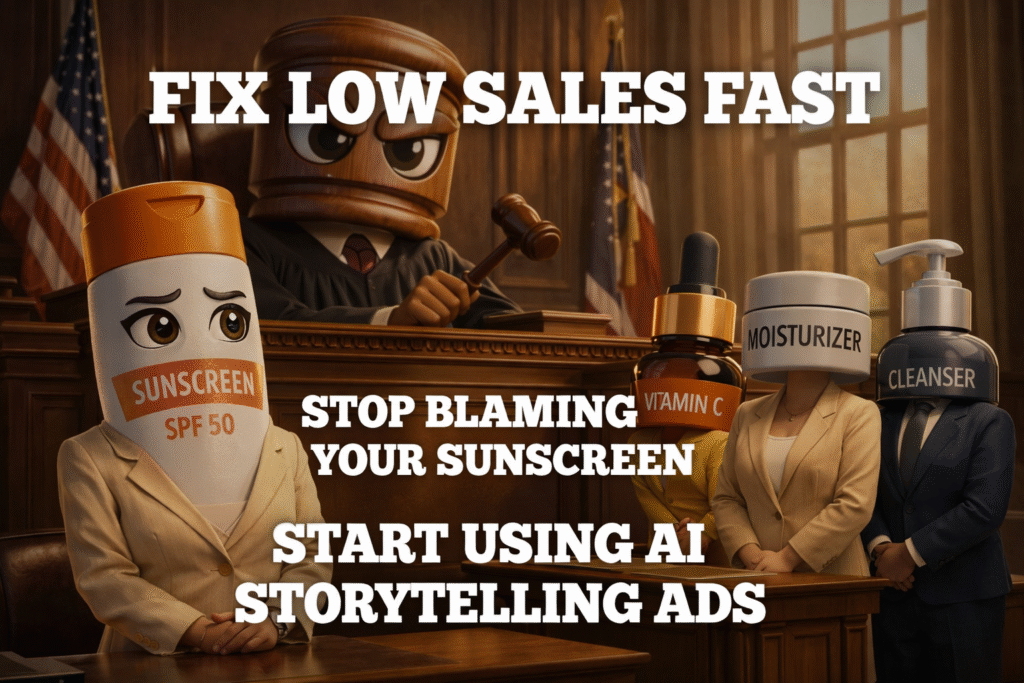
The courtroom was silent.
Judge bangs gavel.
“Sunscreen, you’re accused of being unnecessary.”
Gasps across the room.
Vitamin C Serum stands up:
“She uses me in the morning WITHOUT him!”
Moisturizer follows:
“I hydrate, but I don’t protect.”
Cleanser clears throat:
“I prep the skin — not shield it.”
All eyes turn.
Sunscreen stands confidently.
“I prevent the damage they’re trying to fix.”
Silence.
Judge leans forward.
“Case dismissed. SPF is mandatory.”
And just like that…
The truth was exposed.
Now let’s be honest.
Is sunscreen really the problem?
Or is your marketing failing to make it essential?
If you want to FIX LOW SALES FAST, you need to STOP BLAMING YOUR SUNSCREEN and start educating through AI storytelling ads.
Here’s the reality.
Customers:
Love Vitamin C.
Obsess over moisturizers.
Spend on treatments.
But skip SPF.
And when hyperpigmentation appears?
They blame products.
Sound familiar?
Your sunscreen isn’t unnecessary.
It’s misunderstood.
That misunderstanding costs you revenue every single day.
And that’s where AI for sales and marketing comes in.
Let’s simplify.
If you want to elevate SPF and increase average order value, anchor it inside a routine.
The Court-Approved Routine:
Cleanse
Apply Vitamin C Serum
Moisturize
Always SPF
That final step?
That’s the non-negotiable.
| Factor | Without SPF | With SPF |
|---|---|---|
| Protection | None | Full UV Shield |
| Hyperpigmentation Risk | High | Reduced |
| Anti-aging Effect | Limited | Enhanced |
| Product Results | Compromised | Protected |
| Customer Retention | Lower | Higher |
See what happened?
SPF protects the investment.
When customers understand this, they stop skipping it.
When brands explain this through AI storytelling ads, sales increase naturally.
Traditional ads say:
“Broad spectrum SPF 50. Buy now.”
AI storytelling ads say:
“Sunscreen was accused of being unnecessary… until the truth came out.”
Which one makes people stop scrolling?
Exactly.
AI storytelling ads work because they:
Use emotion
Use education
Show product interaction
Promote full routines
Avoid aggressive selling
That is how you STOP BLAMING YOUR SUNSCREEN and fix perception.
SPF must move from:
Optional → Essential
Add-on → Mandatory
Extra → Protection Investment
And storytelling makes that shift effortless.
When Cleanser says, “I prep but don’t shield,”
When Vitamin C says, “I can’t fight the sun alone,”
You position sunscreen as the final authority.
That builds brand trust.
And trust converts.
The following brands have successfully used narrative or routine-based marketing — the same tactic you can apply to stop blaming your sunscreen and elevate SPF positioning in 2026.
1. Shiseido — “Everyday SPF Protection”
What They Did:
Shiseido positioned SPF not as a seasonal afterthought, but as a daily essential — emphasizing why sunscreen matters with facts, demos, and routine guides. Instead of “Buy SPF,” the messaging focused on Why wear SPF every day and how SPF protects results from serums and moisturizers.
Why It’s Similar:
Educates instead of just sells
Integrates SPF into a routine
Uses emotional benefits (anti-aging, protection)
Multiple products in one narrative
Results:
Shiseido reported increased SPF category growth across markets in 2024–2025, especially in age-conscious segments (source: internal beauty marketing reports & industry analysis), showing that positioning SPF as essential drives higher repeat purchases and customer retention.
Key Lesson:
Education + routine = higher conversion than product-only ads.
2. Clinique — “Stay-Matte Oil Control SPF 30”
What They Did:
Clinique combined SPF with specific skin concerns (oily skin, shine control). The campaign wasn’t a standalone SPF blast — it addressed a problem + solution narrative. Their marketing communicated, “SPF helps your makeup last; SPF helps skin behave.”
Why It’s Similar:
Problem → solution storytelling
Routine integration (sun protection + daily skincare)
Clear benefits tied to everyday lifestyle
Results:
Clinique has maintained SPF products in their top-performing suncare category, with continued year-over-year growth due to targeted messaging and routine linkage in digital ads and email funnels (reported in brand quarterly disclosures).
Key Lesson:
Storytelling works best when tied to specific consumer problems.
3. EltaMD — “Skincare Begins with Protection”
What They Did:
EltaMD’s marketing blends education with dermatologist collaboration — making SPF a trusted expert recommendation. Their digital content explains SPF’s role in protecting other actives like Vitamin C, peptides, and retinoids.
Why It’s Similar:
Educational video + short-form explanations
Promotes SPF as partner to other products
Routine first, product second
Results:
EltaMD’s online SPF search traffic and conversions grew after SEO and educational campaigns highlighted why sunscreen matters daily. Third-party trend analysis shows EltaMD ranking highly for SPF queries (e.g., “best daily SPF”), indicating improved organic visibility from storytelling content.
Key Lesson:
Authority + education improves organic traffic and brand trust — the same effect expected from AI storytelling ads.
4. Supergoop! — “Play Everyday Protection”
What They Did:
Supergoop! built an entire brand around SPF education. Their “Play Everyday Protection” campaign doesn’t just show SPF — it explains when, how, and why SPF should be used, blending lifestyle, routine, and scenarios (indoors, outdoors, makeup layers).
Why It’s Similar:
Routine storytelling
Lifestyle integration
Matter-of-fact educational tone
Promotes multiple products (SPF sprays, lotions, primers)
Results:
Supergoop! has become one of the fastest-growing SPF brands in the U.S., with strong full-funnel marketing. Their multi-platform storytelling and educational content earned loyal repeat customers (Beauty Independent, 2024 trend reports).
Key Lesson:
Repeated education and lifestyle storytelling = category authority.
5. Dermstore — “The Real Reason You Need SPF” (Blog + Video Series)
What They Did:
Dermstore’s content strategy isn’t an ad — it’s mission-based education: “How SPF protects your skin even when you’re indoors.” They mix editorial content, expert quotes, and product recommendations.
Why It’s Similar:
Educates before recommending products
Explains science, steps, and routine order
Connects SPF with overall skincare strategy
Results:
Dermstore’s educational posts rank high for SPF searches, driving organic traffic that converts to multi-product cart checkouts.
Key Lesson:
Education positions SPF as a daily skincare requirement, not a side product — the same narrative you need in AI storytelling ads.
| Brand | Strategy | Story/Routine | AI-Style Lessons |
|---|---|---|---|
| Shiseido | SPF as essential | Integrated into skincare routine | Education first, promote full routine |
| Clinique | Problem-solution focus | SPF + lifestyle concerns | Speak to real pain points |
| EltaMD | Expert authority | SPF as protection partner | Authority + education = trust |
| Supergoop! | Lifestyle storytelling | SPF as everyday necessity | Repeated narrative + product range |
| Dermstore | Content-led education | Blog + video explanations | Organic education feeds paid messaging |
These brands didn’t just list SPF benefits — they told a story, explained why SPF is non-negotiable, and linked SPF to routine outcomes.
Your campaign — “STOP BLAMING YOUR SUNSCREEN” — follows the same blueprint but with AI storytelling ads that:
✔ Craft emotional narratives
✔ Personalize by audience segment
✔ Script multiple products in one ad
✔ Test hooks quickly
✔ Scale without expensive production
That’s AI for sales and marketing applied with storytelling precision.
Here’s how to translate these examples into your campaigns:
Choose the emotional hook — conflict (“accused of being unnecessary”)
Write the narrative arc — problem, misunderstanding, truth reveal
Integrate full routine — cleanser → serum → moisturizer → SPF
Generate ad variations with AI — scripts, visuals, music
Test multiple story angles — drama, humor, education
Measure engagement metrics — watch time, CTR, conversion
When done right, your AI storytelling ads will do what these real brands have done:
👉 Build authority
👉 Educate customers
👉 Increase repeat purchases
👉 Raise average order value
👉 Fix low sales fast
Let’s break it into steps.
1. Hook With Emotion
“They said she ruined the wedding.”
That line alone increases watch time.
2. Introduce Conflict
Foundation is blamed.
3. Reveal Hidden Truth
Primer and moisturizer were ignored.
4. Educate
Explain proper layering.
5. Empower
Show correct routine.
6. Soft CTA
“If you think foundation was betrayed, follow for the truth about beauty.”
Notice what’s missing?
Hard selling.
And that’s why it works.
Education reduces:
Customer confusion
Misuse
Returns
Negative reviews
Education increases:
Product performance
Customer satisfaction
User confidence
Repeat purchase rate
When customers use your product correctly…
It performs better.
When it performs better…
They recommend it.
When they recommend it…
Your CAC drops.
That’s not creativity.
That’s smart strategy.
| Metric | Feature-Only Ads | Storytelling Value Ads |
|---|---|---|
| Click-through rate | Moderate | High |
| Watch time | Low | High |
| Shares | Rare | Frequent |
| Saves | Low | High |
| Brand recall | Weak | Strong |
| Trust level | Transactional | Emotional |
In 2026, saves and shares matter more than impressions.
Because saves indicate perceived value.
And value builds brand equity.
Let’s talk about what to avoid.
1. Marketing SPF Alone
SPF is strongest when paired in routine messaging.
2. Using Fear Without Education
Fear marketing without value reduces trust.
3. Ignoring AI for Sales and Marketing
Manual ad production slows testing.
AI storytelling ads accelerate growth.
4. Treating SPF as a Seasonal Product
SPF is 365 days a year.
If you treat it as summer-only, revenue drops.
If you want to FIX LOW SALES FAST:
Avoid exaggerated protection claims.
Clearly explain reapplication timing.
Ensure SPF messaging matches dermatology standards.
Avoid misleading “SPF in foundation is enough” messaging.
Educate about indoor UV exposure responsibly.
Credibility matters.
✔ Create courtroom-style narrative hooks
✔ Position SPF as the final verdict
✔ Show routine interaction between products
✔ End with authority-based CTA
✔ Use AI variations for audience testing
✔ Focus on education before urgency
✔ Promote cleanser + serum + moisturizer + SPF bundles
Remember:
AI for sales and marketing allows you to test multiple emotional angles instantly.
| Feature | Traditional SPF Ad | AI Storytelling Ads |
|---|---|---|
| Emotional Hook | Weak | Strong |
| Routine Integration | Rare | Natural |
| Bundle Promotion | Low | High |
| Engagement | Moderate | High |
| Authority Positioning | Limited | Elevated |
| Scalability | Manual | AI Powered |
This is how you STOP BLAMING YOUR SUNSCREEN and start building authority.
Step 1: Identify core morning routine
Step 2: Script conflict (SPF accused)
Step 3: Show product interdependence
Step 4: Deliver educational resolution
Step 5: Soft CTA
Step 6: Scale with AI for sales and marketing
Repeat.
Optimize.
Scale.
Storytelling ads increase:
Average order value (customers buy prep + foundation)
Cross-sell opportunities
Lifetime value
Brand authority positioning
Organic reach
When customers understand layering:
They don’t just buy foundation.
They buy the system.
Moisturizer.
Primer.
Foundation.
Setting powder.
Education increases basket size.
Customer says:
“I don’t go outside much.”
Turn it into narrative.
Judge says:
“Even indoors, UV penetrates windows.”
See what happened?
You transformed doubt into authority.
That’s AI storytelling ads done right.
At Samin AI Marketing Hub, we built our entire CGI advertising framework around one core insight: why AI CGI ads are getting worse is not a technology issue—it’s a brand strategy failure. That’s why we don’t start with effects, prompts, or automation. We start with brand perception, buyer psychology, and conversion intent. Before a single CGI frame is generated, we map your beauty brand’s positioning, price point, target audience, and emotional triggers. This ensures every AI CGI ad we create reinforces trust, elevates perceived value, and supports sales—not just views.
We believe why AI CGI ads are getting worse has nothing to do with AI tools—and everything to do with missing brand intelligence. Most CGI ads fail because they start with effects instead of strategy. We reverse this completely.
Before creating any AI CGI visuals, we define:
Brand positioning (luxury, masstige, indie, or clinical beauty)
Target buyer psychology and buying triggers
Price perception and value signaling
Platform-specific ad intent (paid ads vs organic virality)
Conversion goal (trust, education, or purchase)
This strategic foundation ensures every AI CGI ad supports brand perception first, not visual chaos. By anchoring creativity to intent, we eliminate the core problem behind why AI CGI ads are getting worse and build ads that feel premium, intentional, and trustworthy to beauty consumers.
Once strategy is locked, we use AI as an enhancement layer—not a decision-maker. This is where most brands fail and why AI CGI ads lose credibility. Our process is human-directed, conversion-focused, and realism-driven.
Our AI CGI execution framework focuses on:
Studio-grade lighting to maintain luxury perception
Realistic material and texture simulation (glass, liquid, cream, shimmer)
Clear product hierarchy so the product remains the hero
Controlled motion that feels natural, not exaggerated
Camera angles designed to increase perceived product quality
Visual pacing aligned with beauty buying psychology
By blending AI speed with human creative control, we avoid the pitfalls that explain why AI CGI ads are getting worse across the industry. The result is AI CGI advertising that builds trust, supports sales, and protects long-term brand equity—especially for beauty brands targeting premium and U.S. markets.
At Samin AI Marketing Hub, we don’t chase viral visuals.
We build brand-safe AI CGI ads that convert attention into revenue.
STOP BLAMING YOUR SUNSCREEN.
It’s not unnecessary.
It’s misunderstood.
And when you use AI storytelling ads to position SPF as mandatory, you:
Increase bundle purchases
Elevate brand authority
Reduce product misuse
Improve customer retention
Fix low sales fast
In 2026, authority wins.
And education sells.
STOP BLAMING YOUR SUNSCREEN — educate customers.
SPF must be positioned as mandatory.
AI storytelling ads build emotional authority.
AI for sales and marketing increases testing speed.
Routine marketing boosts average order value.
Sunscreen protects results of all other products.
Storytelling converts without feeling salesy.
Ready to start creating viral, high-converting AI video ads for your brand? Join my AI Video Ads Mastery Course and learn how to create cinematic ads in minutes: no studio, no actors, no editing skills needed.
 Enroll now and transform the way you market in 2026.
Find quick answers to the most common questions about STOP Blaming Your SUNSCREEN in 2026 and increase sales. Discover how this simple editing step can instantly make your content more engaging, professional, and ready to grab attention in 2026.
Low SPF sales often stem from weak positioning, not weak formulas. Customers skip sunscreen because they do not see it as essential. AI storytelling ads reposition SPF as mandatory within the skincare routine.
AI storytelling ads integrate SPF into emotional narratives that highlight its necessity. Instead of pushing features, they demonstrate how sunscreen protects other products’ results. This increases perceived value and bundle purchases.
Yes, AI for sales and marketing allows small brands to produce high-quality storytelling content without large production budgets. It enables rapid creative testing and personalization. This helps emerging brands compete effectively.
Why is sunscreen considered mandatory in skincare routines?
Sunscreen prevents UV damage, hyperpigmentation, and premature aging. Without it, other treatments lose effectiveness. That is why dermatologists consider SPF the final essential step.
How can I fix low sales fast with SPF products?
Integrate sunscreen into a structured routine narrative. Use AI storytelling ads to demonstrate its non-negotiable role. Promote bundles instead of standalone products.
Should SPF be marketed year-round?
Absolutely. UV exposure happens every day, even indoors. Year-round messaging stabilizes revenue.
Does AI storytelling ads reduce ad fatigue?
Yes, AI generates multiple creative variations quickly. This prevents repetitive content. Fresh narratives maintain engagement.
Why do customers skip sunscreen?
Many believe it is only necessary for beach days. Education corrects this misconception. Storytelling reinforces daily necessity.
How does routine marketing improve authority?
When you teach the full skincare process, you position your brand as expert. Authority builds trust. Trust increases conversion.
Is this strategy sustainable long term?
Yes, because it focuses on education rather than hype. AI for sales and marketing simply amplifies consistent authority messaging. Sustainable trust leads to long-term growth.