


Lipstick stormed into the bridal suite.
“She says I don’t last!”
Lip Liner snapped back:
“She never outlines first!”
Lip Scrub rolled her eyes:
“She applies color on dry lips.”
Lip Gloss flipped her hair:
“And I’m only invited for selfies.”
Awkward silence.
Then Lipstick smirked.
“I’m long-lasting. She just needed the squad.”
And there it is.
The same way customers blame lipstick for not lasting…
Beauty founders blame products for low sales.
But here’s the truth.
It’s not always the product.
It’s the missing routine.
And in 2026, brands that understand this — and use AI storytelling ads to communicate it — fix low sales fast.
Let’s break it down.
Here’s what most brands get wrong.
They market lipstick as a standalone hero.
But customers use it incorrectly.
And when it fails?
They leave bad reviews.
Sound familiar?
Now imagine this instead:
You teach them the routine.
You show them the squad.
You explain the why.
That’s where AI for sales and marketing changes the game.
Let’s get practical.
If you truly want to STOP BLAMING YOUR LIPSTICK, educate customers on this 4-step routine:
1. Lip Scrub – The Prep Stage
Exfoliate first.
Dry flakes prevent smooth pigment adherence.
Uneven texture causes cracking.
Without prep, lipstick cannot perform optimally.
2. Lip Liner – The Structure
Define with liner.
Lip liner prevents feathering.
It improves longevity.
It adds depth and dimension.
Skipping liner is like building a house without a frame.
3. Lipstick – The Core Color
Apply lipstick evenly.
Use thin layers.
Blot.
Reapply.
Pigment builds best gradually.
4. Lip Gloss – The Dimension
Add gloss strategically.
Center of lips only.
Not all over.
Gloss creates dimension and fullness.
| Factor | Lipstick Alone | Full Lip Routine |
|---|---|---|
| Longevity | Moderate | High |
| Smoothness | Uneven on dry lips | Smooth and polished |
| Customer Satisfaction | Inconsistent | Reliable |
| Average Order Value | Low | High |
| Review Quality | Mixed | Positive |
See the difference?
Now imagine building your entire marketing around this story.
Traditional ads say:
“Long-lasting lipstick. Buy now.”
AI storytelling ads say:
“They blamed her for fading. But she was never prepped.”
Which one builds emotional connection?
Exactly.
AI for sales and marketing allows you to:
Create narrative-based ads at scale
Personalize scripts by audience segment
Promote 4 products in 1 ad naturally
Reduce return rates
Increase bundle sales
And the best part?
It doesn’t feel salesy.
It feels educational.
Let’s revisit the foundation story.
What did it do?
✔ Explained oxidation
✔ Explained moisturizer’s role
✔ Explained primer’s function
✔ Explained proper powder use
✔ Removed product blame
✔ Built brand authority
And here’s the magic:
It sold without selling.
That’s 2026 marketing.
Customers want:
Guidance
Authority
Simplicity
Emotional connection
When you show Lipstick arguing with Lip Liner in a romantic drama format…
You entertain.
You educate.
You sell — indirectly.
That’s AI storytelling ads working correctly.
Here’s the formula:
Problem + Emotion + Education + Solution + Authority = Trust
Trust = Conversions
Conversions + Retention = Growth
When your foundation ad says:
“Stop blaming your foundation. It’s reacting to oil. Here’s how to prevent oxidation.”
You position your brand as:
✔ Expert
✔ Honest
✔ Helpful
✔ Different
And differentiation wins markets.
Let’s break it into steps.
1. Hook With Emotion
“They said she ruined the wedding.”
That line alone increases watch time.
2. Introduce Conflict
Foundation is blamed.
3. Reveal Hidden Truth
Primer and moisturizer were ignored.
4. Educate
Explain proper layering.
5. Empower
Show correct routine.
6. Soft CTA
“If you think foundation was betrayed, follow for the truth about beauty.”
Notice what’s missing?
Hard selling.
And that’s why it works.
Education reduces:
Customer confusion
Misuse
Returns
Negative reviews
Education increases:
Product performance
Customer satisfaction
User confidence
Repeat purchase rate
When customers use your product correctly…
It performs better.
When it performs better…
They recommend it.
When they recommend it…
Your CAC drops.
That’s not creativity.
That’s smart strategy.
| Metric | Feature-Only Ads | Storytelling Value Ads |
|---|---|---|
| Click-through rate | Moderate | High |
| Watch time | Low | High |
| Shares | Rare | Frequent |
| Saves | Low | High |
| Brand recall | Weak | Strong |
| Trust level | Transactional | Emotional |
In 2026, saves and shares matter more than impressions.
Because saves indicate perceived value.
And value builds brand equity.
| Feature | Traditional Product Ad | AI Storytelling Ads |
|---|---|---|
| Focus | Single product | Full routine |
| Emotional Hook | Minimal | Strong narrative |
| Engagement | Moderate | High |
| Bundle Promotion | Rare | Natural |
| Conversion Potential | Lower | Higher |
| Scalability | Limited | Automated with AI |
This is why AI for sales and marketing dominates 2026.
Let’s talk about what to avoid.
1. Selling Only One Product
This reduces AOV (Average Order Value).
Promote the system instead.
2. No Education in Ads
If customers don’t know how to use it, they misuse it.
Then blame the lipstick.
3. Overpromising Longevity
Instead of “24-hour wear,” explain routine-based longevity.
4. Ignoring AI for Sales and Marketing
Brands that manually create ads lose speed.
AI storytelling ads allow rapid creative testing.
If you want to fix low sales fast:
Avoid exaggerated claims.
Ensure routine instructions are accurate.
Test scripts before scaling ads.
Keep branding consistent across characters.
Avoid overwhelming customers with too many steps.
Education must simplify — not complicate.
Use emotional conflict (Lipstick blamed)
✔ Introduce supporting products as heroes
✔ Show transformation results
✔ End with soft CTA
✔ Promote bundles visually
✔ Use AI variations for A/B testing
✔ Focus on routine benefits over features
Technique impacts conversion more than you think.
Step 1: Identify product squad (Lip Scrub, Liner, Lipstick, Gloss)
Step 2: Create emotional script
Step 3: Use AI storytelling ads generator
Step 4: Launch multi-format ads (Reels, TikTok, Shorts)
Step 5: Track bundle conversion
Step 6: Optimize using AI data feedback
Repeat.
Scale.
Win.
Storytelling ads increase:
Average order value (customers buy prep + foundation)
Cross-sell opportunities
Lifetime value
Brand authority positioning
Organic reach
When customers understand layering:
They don’t just buy foundation.
They buy the system.
Moisturizer.
Primer.
Foundation.
Setting powder.
Education increases basket size.
Negative review:
“Doesn’t last.”
Turn it into ad hook:
“She says I don’t last…”
See what happened?
You transformed criticism into content.
That’s AI for sales and marketing thinking.
At Samin AI Marketing Hub, we built our entire CGI advertising framework around one core insight: why AI CGI ads are getting worse is not a technology issue—it’s a brand strategy failure. That’s why we don’t start with effects, prompts, or automation. We start with brand perception, buyer psychology, and conversion intent. Before a single CGI frame is generated, we map your beauty brand’s positioning, price point, target audience, and emotional triggers. This ensures every AI CGI ad we create reinforces trust, elevates perceived value, and supports sales—not just views.
We believe why AI CGI ads are getting worse has nothing to do with AI tools—and everything to do with missing brand intelligence. Most CGI ads fail because they start with effects instead of strategy. We reverse this completely.
Before creating any AI CGI visuals, we define:
Brand positioning (luxury, masstige, indie, or clinical beauty)
Target buyer psychology and buying triggers
Price perception and value signaling
Platform-specific ad intent (paid ads vs organic virality)
Conversion goal (trust, education, or purchase)
This strategic foundation ensures every AI CGI ad supports brand perception first, not visual chaos. By anchoring creativity to intent, we eliminate the core problem behind why AI CGI ads are getting worse and build ads that feel premium, intentional, and trustworthy to beauty consumers.
Once strategy is locked, we use AI as an enhancement layer—not a decision-maker. This is where most brands fail and why AI CGI ads lose credibility. Our process is human-directed, conversion-focused, and realism-driven.
Our AI CGI execution framework focuses on:
Studio-grade lighting to maintain luxury perception
Realistic material and texture simulation (glass, liquid, cream, shimmer)
Clear product hierarchy so the product remains the hero
Controlled motion that feels natural, not exaggerated
Camera angles designed to increase perceived product quality
Visual pacing aligned with beauty buying psychology
By blending AI speed with human creative control, we avoid the pitfalls that explain why AI CGI ads are getting worse across the industry. The result is AI CGI advertising that builds trust, supports sales, and protects long-term brand equity—especially for beauty brands targeting premium and U.S. markets.
At Samin AI Marketing Hub, we don’t chase viral visuals.
We build brand-safe AI CGI ads that convert attention into revenue.
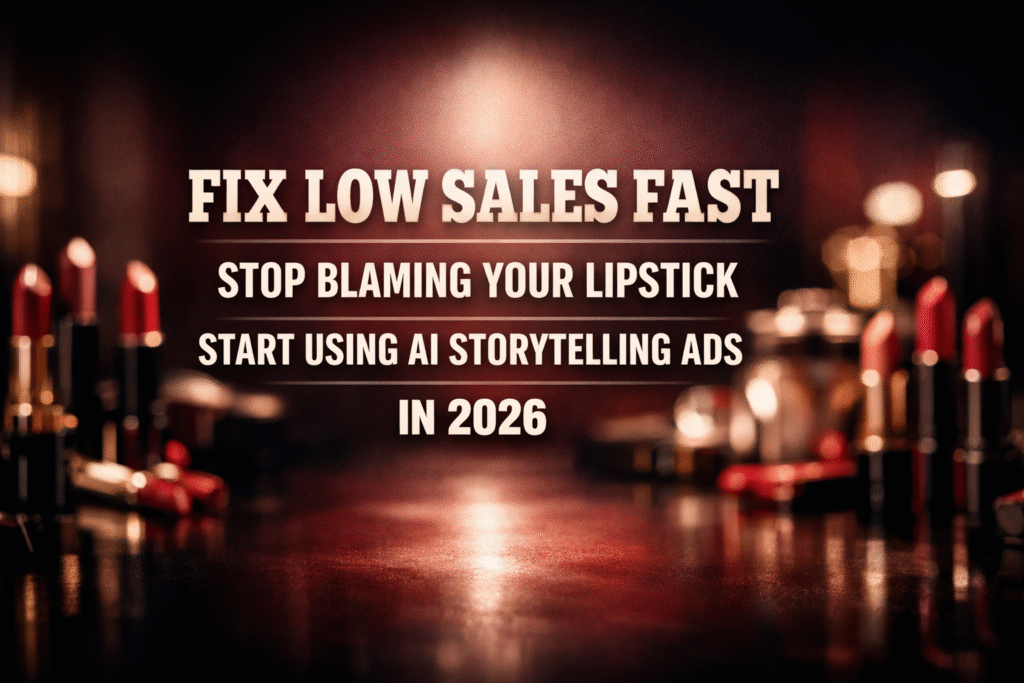
STOP BLAMING YOUR LIPSTICK.
Start teaching the routine.
Start using AI storytelling ads.
Start promoting product squads instead of solo heroes.
In 2026, the brands that win are not louder.
They are smarter.
And they educate before they sell.
STOP BLAMING YOUR LIPSTICK — educate customers.
Lip routine increases longevity and satisfaction.
AI storytelling ads promote multiple products naturally.
AI for sales and marketing scales content creation.
Bundle strategy increases AOV.
Emotional storytelling improves engagement.
Routines to Revenue System drives sustainable growth.
Ready to start creating viral, high-converting AI video ads for your brand? Join my AI Video Ads Mastery Course and learn how to create cinematic ads in minutes: no studio, no actors, no editing skills needed.
 Enroll now and transform the way you market in 2026.
Find quick answers to the most common questions about STOP Blaming Your LIPDTICK in 2026 and increase sales. Discover how this simple editing step can instantly make your content more engaging, professional, and ready to grab attention in 2026.
When sales are low, the issue is often not the lipstick formula but the way it is positioned and marketed. Customers may not understand how to prep, line, and layer properly, which leads to disappointment and poor reviews. Instead of telling founders to STOP BLAMING YOUR LIPSTICK, the real solution is to educate through AI storytelling ads that show the full lip routine in action.
AI storytelling ads naturally present multiple products as a team instead of pushing a single item aggressively. When customers see Lip Scrub, Lip Liner, Lipstick, and Gloss working together in a story, they understand why each product matters. This increases perceived value and boosts average order value without feeling salesy.
Yes, AI for sales and marketing reduces production costs by generating multiple creative variations quickly. Instead of filming new content every week, AI tools can create script variations, hooks, and emotional angles instantly. This allows brands to test more ads at lower cost and scale only the highest-performing ones.
Why is routine marketing more effective?
Routine marketing works because customers want clear steps and guidance, not just product features. When you present a lip system instead of a single lipstick, you position your brand as an expert authority. This approach builds trust, increases satisfaction, and leads to repeat purchases.
How can I fix low sales fast?
To fix low sales fast, shift your messaging from “buy this lipstick” to “here’s the full lip routine that works.” Use AI storytelling ads to demonstrate the emotional transformation and educational value behind each step. When customers understand how to use your products correctly, conversion rates naturally increase.
Do AI storytelling ads work for small brands?
Absolutely, AI storytelling ads are especially powerful for small beauty brands with limited budgets. AI for sales and marketing allows smaller teams to produce cinematic, narrative-driven ads without expensive production crews. This levels the playing field and helps emerging brands compete with established names.
Should I stop selling individual lipsticks?
No, you should still offer individual lipsticks, but market them within a routine framework. When customers see how the lipstick performs best with scrub and liner, they are more likely to upgrade their purchase. This approach increases revenue while still maintaining flexibility for buyers.
How often should I refresh AI ads?
You should test new variations consistently, ideally every few weeks, depending on campaign performance. AI for sales and marketing makes it easy to generate fresh hooks, emotional angles, and scripts without starting from scratch. Continuous creative testing ensures your brand stays relevant and competitive in 2026.
What platforms work best for storytelling ads?
Short-form vertical platforms such as Reels, TikTok, and Shorts are leading performance channels in 2026. These platforms favor emotional storytelling, relatable humor, and educational content. AI storytelling ads fit perfectly into these formats because they combine entertainment and value in under 60 seconds.
Is this strategy sustainable long term?
Yes, this strategy is sustainable because it builds brand trust rather than relying on hype. When you STOP BLAMING YOUR LIPSTICK and instead focus on education and routine clarity, customer satisfaction increases. AI storytelling ads simply amplify that trust at scale, making growth more predictable and consistent.