



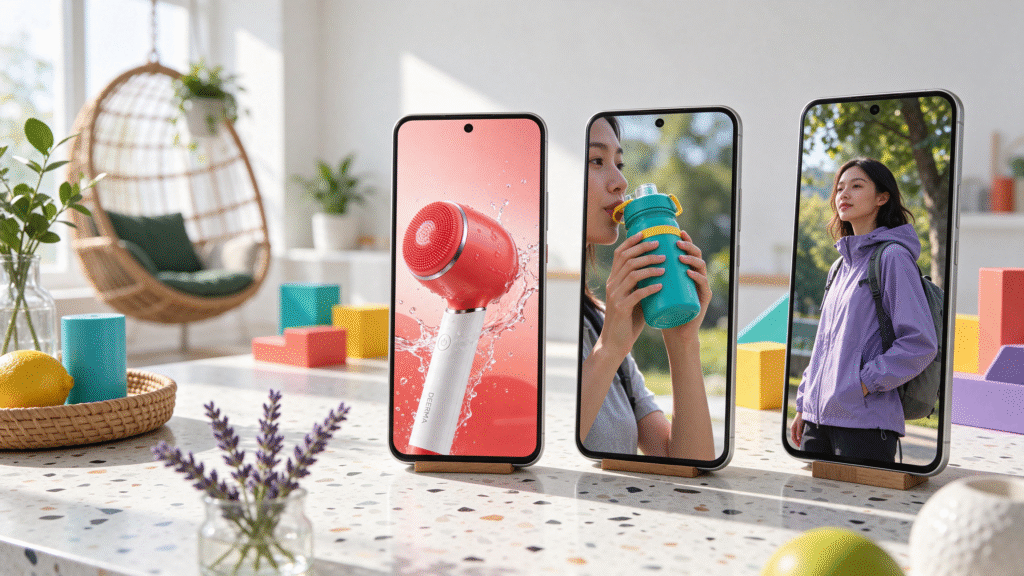
Short-form video ads for ecommerce are brief, mobile-first advertisements designed to explain a product, create interest, and guide shoppers toward a next step. They can appear between organic videos, in social feeds, on product pages, in email campaigns, or in retargeting sequences.
A short video is not automatically a strong advertisement. It still needs a clear audience, a relevant hook, one central message, accurate product information, readable captions, and a call to action that matches the destination page.
The best short-form ads feel natural in the feed while still serving a business purpose. They may use product demonstrations, creator-style presentations, voiceover, captions, animation, AI-assisted production, or a combination of formats.
For a broader campaign structure, explore Samin AI Marketing Hub’s AI video ad campaigns before choosing the short-form concepts to produce.
What are short-form video ads for ecommerce?
Short-form video ads are brief videos created for fast, mobile-first viewing. The exact duration depends on the platform, campaign objective, audience, and amount of information required.
A short-form ecommerce ad may:
•Introduce a product
•Demonstrate one feature
•Show a problem and solution
•Answer a customer question
•Present a product benefit
•Compare product options
•Share an approved customer experience
•Announce a launch or offer
•Remind a previous visitor to return
Google Ads lists YouTube Shorts ads as a mobile-optimized video format that appears between organic Shorts and allows viewers to move through the feed. Its official video ad formats guidance explains how Shorts ads work, where they appear, and how calls to action connect to a designated landing page.
Why ecommerce brands use short-form video ads
Ecommerce shoppers often discover products while browsing mobile feeds. A short video can introduce a product in the same environment where the shopper already watches content, while giving the brand an opportunity to demonstrate a benefit or answer a question.
Short-form ads can help a brand:
•Test different opening hooks quickly
•Explain a product benefit in a compact format
•Create variations for different customer segments
•Adapt one campaign idea across several placements
•Use product demonstrations in paid social creative
•Support launches and seasonal promotions
•Retarget people who viewed or visited a product page
•Learn which messages produce qualified traffic and sales
The goal is not to create as many clips as possible. The goal is to create useful variations that answer a campaign question.
The short-form video ad structure that works
1. Hook
The opening gives the viewer a reason to continue watching. It can introduce a customer problem, ask a question, show a product action, reveal a visual detail, or present a specific benefit.
Examples include:
•“Still struggling with this part of your routine?”
•“Here is how this product works in seconds.”
•“What is the difference between these two options?”
•“Three details to check before choosing your next product.”
•“See what comes inside the box.”
The hook should be relevant to the intended customer. A dramatic opening that attracts the wrong viewer may produce attention without qualified traffic.
2. Product or problem context
Show what the video is about quickly. The viewer should not need to wait through a long brand introduction before seeing the product or understanding the problem.
Keep the product recognizable. If the product is small, use a close-up. If the product needs context, use a wider shot and then return to the important detail.
3. Demonstration or proof
Show the product being used, opened, applied, compared, assembled, worn, or placed in context. Proof can also include an accurate specification, approved review excerpt, product detail, or real process.
Do not use a generated scene as proof of a real customer experience or manufacturing process unless the scene accurately represents what happened and is presented clearly.
4. Benefit
Connect the product action to one customer benefit. Avoid listing every feature in a short video. One clear benefit is easier to understand and test.
A useful benefit is specific enough to guide the visual. Instead of saying “high quality,” show the material, construction, process, or use case that supports the claim.
5. Call to action
Tell the viewer what to do next. The call to action might be “Shop now,” “See how it works,” “Compare options,” “Explore the collection,” “Learn more,” or “Book a consultation.”
The landing page should match the promise in the video. Send a product demonstration to the relevant product page, not to an unrelated page.
Google’s short-form video advertising guidance recommends creative that feels at home in the feed, uses conversational communication, and gives viewers a clear reason to engage.
7 short-form video ad ideas for ecommerce brands
1. Problem-and-solution ad
Begin with a problem the audience recognizes. Show the product solving one part of that problem, then finish with a clear next step.
This format works best when the problem is specific. “Make life easier” is broad. “Need a faster way to organize this small space?” gives the video a clear direction.
2. Product demonstration ad
Show one action that helps the viewer understand the product. Use close-ups, captions, and a simple explanation.
For more demonstration-led creative, explore AI product demonstration videos for ecommerce brands.
3. Product comparison ad
Compare two options, sizes, variants, or use cases. Keep the comparison factual and easy to follow. A shopper should understand which option may suit a particular need.
Avoid unsupported claims about competitors or statements that cannot be verified.
4. Customer-question ad
Turn a common product-page or support question into a short video. Examples include “How do I use it?”, “What is included?”, and “Which option is right for me?”
Question-led ads can feel useful because they address a real point of uncertainty.
5. Creator-style product ad
Use a direct, conversational presentation that fits the platform. A creator may speak to camera, show the product in a routine, or explain a specific benefit.
An AI-generated presenter should not be described as a real customer who personally used the product when that is not true. For related creative, explore AI UGC ads.
6. Unboxing and product-details ad
Show what the shopper receives. This can include packaging, components, accessories, instructions, or variant details.
Keep the video current whenever the offer or packaging changes.
7. Retargeting reminder ad
A retargeting ad can answer an objection, demonstrate a feature, compare options, or remind a visitor why the product was relevant.
Use a message appropriate for someone who has already visited the product page. The video does not need to repeat the entire introduction.
How to create short-form video ads for ecommerce
Step 1: Define the objective
Decide whether the video is designed for awareness, product education, traffic, sales, lead generation, a launch, or retargeting.
The objective determines the message, destination page, call to action, and success metric. A video designed to generate product-page traffic should not be judged only by view count.
Step 2: Identify the audience and buying stage
Describe the viewer by problem, product interest, or buying stage. The viewer may be discovering the category, comparing products, revisiting a product page, or ready to purchase.
A first-time viewer may need context. A returning viewer may need proof, a comparison, or an answer to an objection.
Step 3: Choose one message
Select one product benefit or customer question. Keep the video focused enough that the viewer can repeat the main idea after watching.
If a campaign needs several messages, create separate variations rather than crowding every message into one short clip.
Step 4: Prepare approved product references
Gather current product photographs, packaging images, product details, approved claims, pricing, offer terms, logos, brand colors, and existing footage.
Mark details that must remain exact, including product shape, labels, colors, materials, ingredients, dimensions, accessories, and instructions. AI-assisted visuals can accidentally change these details.
Step 5: Write the script and storyboard
A short script should specify what is said, what appears on screen, and what the viewer should do next. A simple structure is:
1.Relevant hook.
2.Product or problem context.
3.Demonstration or proof.
4.One main benefit.
5.Clear call to action.
Write the visual beside every spoken line. Captions should be concise and readable on a small screen.
Step 6: Create platform-ready versions
A single master video may need different versions for TikTok, Instagram Reels, YouTube Shorts, paid social feeds, product pages, and email.
Review the crop, opening frame, pacing, captions, sound, safe areas, product visibility, duration, thumbnail, and call to action for each placement.
Do not assume that resizing a horizontal video creates a good vertical ad. Reframe the visual so the product and presenter remain clear.
Step 7: Test one major change at a time
Create purposeful variations. Keep the audience, product, offer, and destination page consistent while testing one major variable such as:
•Problem-led hook versus benefit-led hook
•Product demonstration versus creator-style presentation
•Convenience benefit versus quality benefit
•Question-led opening versus statement-led opening
•Shorter edit versus longer explanation
•Direct purchase CTA versus educational CTA
Testing one major variable makes the result easier to interpret. If every element changes at once, you may see a different result without learning what caused it.
For a deeper testing process, explore AI video ad creative testing for ecommerce brands.
Captions, sound, and mobile viewing
Many viewers encounter short-form video while moving through a feed, and some may watch without sound. Make the central message understandable through the visual and captions.
Use high-contrast text, readable sizing, safe margins, and short lines. Do not cover the product, a person’s face, or important interface controls.
Voiceover should be clear and consistent. Music should support the message rather than compete with it. If a spoken claim matters, repeat it in accurate captions.
How to measure short-form video ad performance
Choose the primary metric before launching. For awareness, review reach, qualified attention, completed views, and meaningful engagement. For traffic, review qualified clicks and landing-page views. For ecommerce sales, review add-to-cart actions, checkout starts, purchases, revenue, and return on ad spend where tracking supports those measures.
A high view count does not automatically mean the video is successful. A shorter video may generate many views but few qualified visits. A product demonstration may have fewer views but produce more add-to-cart actions.
Track the hook, format, audience, placement, destination page, budget, dates, and results. This turns creative production into a learning system instead of a series of guesses.
Responsible short-form advertising
Keep product claims accurate and current. Do not invent customer testimonials, reviews, before-and-after results, or product experiences. Do not use a person’s face, voice, or likeness without authorization.
If a virtual presenter, generated scene, or AI-assisted creative could mislead viewers about what is real, present it honestly. Review every final version before publishing and confirm that the landing page matches the offer in the ad.
Responsible advertising protects customers and helps the brand build trust over time.
Final checklist before publishing
Confirm that:
•The campaign objective is defined.
•The audience and buying stage are clear.
•The hook is relevant to the intended viewer.
•The product appears early and remains accurate.
•The video communicates one main benefit.
•The captions work on mobile.
•The video is understandable without sound.
•The CTA matches the destination page.
•The format is adapted to the intended platform.
•The product, price, offer, and claims are current.
•Tracking is working.
•A person has reviewed the final creative.
Conclusion
Short-form video ads for ecommerce can help brands demonstrate products, answer customer questions, test creative messages, and guide mobile shoppers toward a clear next step. The strongest ads feel natural in the feed while remaining accurate, useful, and connected to a measurable campaign goal.
Start with the customer problem, choose one benefit, show the product clearly, use readable captions, and test one major creative change at a time. AI can support scripts, storyboards, visuals, voiceover, editing, and variations, but human review remains essential.
If you need help creating short-form ecommerce ads, explore Samin AI Marketing Hub’s short video ads service, AI video marketing services, and AI video ad production services. You can also view the portfolio or book a 30-minute consultation.