


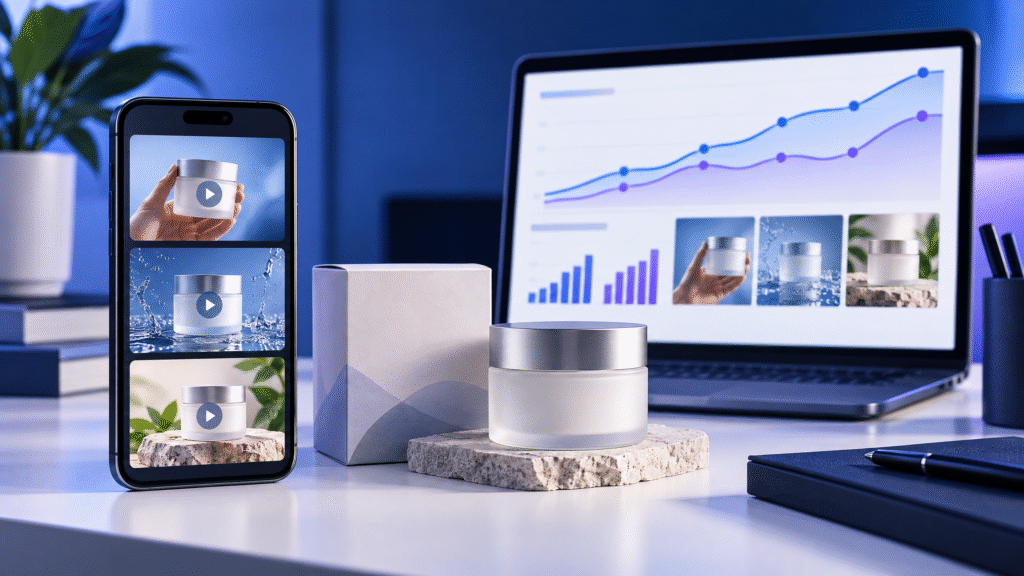
AI video ad creative testing is the process of comparing different video concepts, openings, messages, formats, and calls to action to learn what helps an ecommerce campaign perform better. Artificial intelligence can make it faster to produce useful variations, but testing still requires a clear audience, a defined objective, accurate product information, and a consistent measurement plan.
A strong testing system is not about creating dozens of random videos. It is about changing one important creative variable at a time, giving each version a fair opportunity, and using meaningful campaign results to guide the next decision.
If you are planning a new ecommerce campaign, start with a clear AI video ad campaign strategy and then use the framework below to develop and evaluate your creative variations.
Why creative testing matters for ecommerce brands
Ecommerce customers do not all respond to the same message. One shopper may want to see how a product works. Another may want proof of quality, a comparison, a quick demonstration, or an answer to a specific question.
A single video can communicate only one main idea clearly. Creative testing helps a brand discover which idea, presentation, and call to action are most relevant to its audience.
Testing can help you learn whether your audience responds more strongly to:
•A problem-led opening or a product-led opening
•A product demonstration or a lifestyle scene
•A UGC-style presentation or a polished CGI concept
•A short direct message or a longer educational explanation
•A benefit-focused caption or a feature-focused caption
•A product-page call to action or a broader brand message
The objective is not to declare a permanent winner. Audience behavior can change by platform, season, offer, placement, and buying stage. The objective is to build a repeatable creative learning process.
7 practical ways to test AI video ad creative
1. Test the first three seconds
The opening should quickly establish why the viewer should continue watching. Test different hooks while keeping the product, audience, offer, and destination page as consistent as possible.
For example, one version could open with a customer problem: “Still spending too long preparing your morning routine?” A second version could open with the product in use. A third could lead with a clear benefit or question.
The strongest opening is not always the loudest one. It is the opening that attracts the right viewer and leads to qualified attention. Review early retention alongside clicks and conversions so that a high-view version does not automatically win if it attracts the wrong audience.
2. Test one product benefit at a time
Many ecommerce videos become difficult to follow because they list every feature. Create separate versions that each focus on one meaningful benefit.
A product video might test convenience, durability, appearance, speed, comfort, ease of use, or a specific customer outcome. Support the selected benefit with an accurate demonstration, approved specification, or realistic use case.
For demonstration-led creative, explore AI product demonstration videos for ecommerce brands. A clear demonstration can often answer a shopper’s question more effectively than a general promotional message.
3. Compare UGC-style, spokesperson, and product-led formats
Different creative formats create different viewing experiences. UGC-style ads can feel direct and conversational. A spokesperson video can explain a product or answer a question. A product-led video can keep attention on the item, its details, and its use.
AI can support each format, but the presentation must remain honest. Do not describe an AI-generated presenter as a real customer, and do not show generated scenes as documentary evidence of a real process.
You can compare AI UGC ads, AI spokesperson ads, and product-focused creative using the same campaign objective. This makes it easier to understand whether the format itself is affecting performance.
4. Adapt the same concept for each placement
A video that works in a vertical mobile feed may not work in a square placement, a product page, or a YouTube campaign. Test suitable versions for the intended destination instead of simply resizing one master file.
Review the opening frame, captions, product visibility, safe areas, sound, duration, and call to action for each placement. Google Ads supports multiple video formats, including skippable in-stream, in-feed, bumper, and YouTube Shorts placements. You can review the current format guidance in Google’s official About video ad formats resource.
For short-form mobile creative, see AI short video ads for ecommerce brands. For more cinematic or visual concepts, explore AI CGI ads.
5. Test the call to action and destination page
A video can generate attention but still produce weak business results if the next step is unclear. Compare calls to action such as “Shop now,” “See how it works,” “Explore the collection,” “Get the guide,” or “Book a consultation” according to the campaign goal.
The destination should match the promise in the video. A demonstration-led video should lead to a page where shoppers can learn more about the product. A service-focused video should lead to a relevant service page or enquiry path instead of a generic homepage.
For service enquiries, the AI video ads portfolio and About page can support visitors who want to understand the creative approach before making contact.
6. Use customer questions as test ideas
Customer questions are a useful source of practical creative briefs. Review product-page questions, support messages, comments, reviews, and sales conversations. Then turn recurring questions into short video concepts.
A question-led test might compare these openings:
•“What is included in the box?”
•“How do you use this product?”
•“Which option is right for your routine?”
•“How long does setup take?”
•“What makes this version different?”
This approach helps the video respond to an actual information need instead of relying on a vague brand statement. It can also create a useful sequence of educational videos for first-time visitors and retargeting audiences.
7. Test proof, process, and storytelling separately
Proof-led creative can show an accurate product demonstration, approved specification, comparison, review excerpt, or customer question. Process-led creative can explain preparation, packaging, craftsmanship, or quality checks when those details are real and authorized.
Storytelling-led creative can place the product in a relatable situation or routine. These approaches should not be blended into one crowded video unless each part has a clear purpose.
For process-focused campaigns, explore AI process ads. For narrative concepts, see AI storytelling ads.
How to run a fair creative test
Begin with one campaign objective, one audience, and one primary conversion event. Decide in advance which creative variable will change. If the hook, duration, offer, format, audience, and landing page all change at once, the result will be difficult to interpret.
Prepare a small set of purposeful variations. Each version should use the same approved product references, brand information, and offer details. Check product shape, color, packaging, labels, claims, captions, voiceover, and pricing before launch.
Allow enough time and delivery for the campaign to produce meaningful data. A video with a higher view rate may not be the best business asset if another version produces more qualified clicks, add-to-cart actions, purchases, or enquiries. Choose the primary success metric before reviewing the results.
TikTok’s official Creative Center Top Ads can also provide examples of high-performing auction ads and creative patterns. Use it for inspiration, not for copying another brand’s concept or claims.
Metrics to review
The right metrics depend on the campaign goal. For awareness, review reach, completed views, attention, and quality of engagement. For traffic, review qualified clicks, landing-page views, and the behavior after the click. For ecommerce conversion, review add-to-cart actions, checkout starts, purchases, revenue, and return on ad spend where the tracking setup supports it.
Review both creative and business metrics. A strong video should attract the intended audience and move that audience toward the next step. Do not optimize only for inexpensive views if the campaign is intended to generate sales.
Product accuracy and responsible AI advertising
AI-generated visuals can accidentally change product proportions, packaging, materials, ingredients, colors, or instructions. Compare every final version with approved reference material before publishing.
Keep claims accurate and current. If a scene is illustrative or generated, present it in a way that does not mislead the viewer about real product performance, customer experience, or production processes. Human review remains essential even when AI supports scripting, storyboarding, visual development, voiceover, or editing.
Final thoughts
The best AI video ad testing system combines creative variety with disciplined measurement. Start with the customer problem, choose one clear benefit, create purposeful variations, and connect every version to an appropriate destination page.
When the test reveals a promising direction, develop it further with additional hooks, demonstrations, formats, and calls to action. If you need help creating a campaign, explore Samin AI Marketing Hub’s AI video ad services or AI video ad production services.
Ready to create a stronger testing system for your ecommerce brand? Book a 30-minute call to discuss your next AI video advertising campaign.