



Let’s start with a simple truth.
You don’t need a factory.
You don’t need a massive budget.
And you definitely don’t need a physical store.
Today, thousands of founders are building beauty brands from their living rooms.
But here’s the catch.
Most people fail before their first sale.
Why?
Because they start with products…
Instead of starting with strategy.
So in this guide, you’ll learn the complete roadmap to sell beauty products from home, from research to store setup to marketing with AI Video Ads.
Let’s begin.
Imagine this.
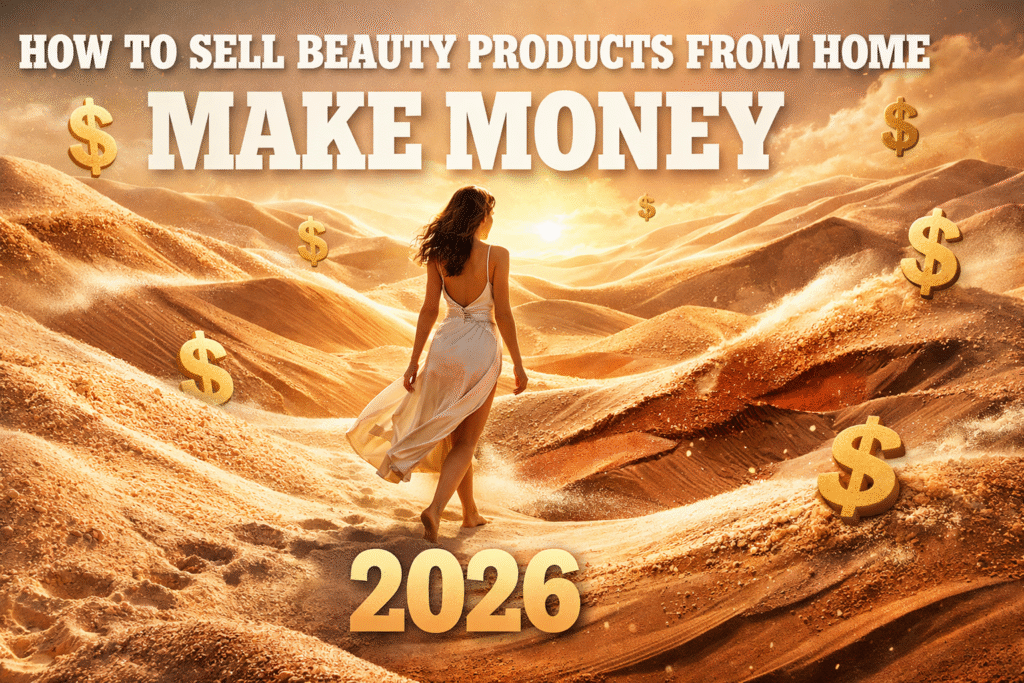
A massive desert made entirely of foundation powder.
A woman walks across dunes of soft beige powder.
The wind blows…
And different foundation shades appear beneath the sand.
She touches the powder.
Instantly, it transforms into flawless skin.
Voiceover:
“Welcome to the desert of perfect skin.”
This type of creative concept works incredibly well for AI Video Ads because it transforms a beauty product into a cinematic story.
And that’s exactly how modern beauty brands capture attention.
But before marketing…
You need a product people actually want.
Before you start selling, you must answer one question.
What beauty products are people already searching for?
Here are the best product categories in 2026:
| Category | Why It Sells |
|---|---|
| Skincare routines | Repeat purchase behavior |
| Sunscreen | Daily use product |
| Lip products | Viral social media potential |
| Brow products | Routine-based |
| Foundation | High shade demand |
| Serums | Premium margins |
Use platforms like:
Google Trends
TikTok
Amazon
Search for trending beauty topics and identify problems people want solved.
For example:
“Foundation for oily skin”
“SPF for acne-prone skin”
“Serum for dark spots”
Problems create products.
Products create businesses.
Before launching, analyze successful beauty brands.
Look at:
product pricing
packaging
customer reviews
ad creatives
Some strong beauty competitors include:
Glossier
Rare Beauty
Fenty Beauty
Study:
how they present products
how they tell stories
how they demonstrate results
This research helps you position your brand differently.
To sell beauty products from home, choose one of these models.
| Model | Investment | Control |
|---|---|---|
| Dropshipping | Low | Low |
| Private Label | Medium | Medium |
| Handmade Beauty | Low | High |
| Wholesale Reselling | Medium | Medium |
Most beginners choose private label skincare.
Why?
Because you can:
customize packaging
build brand identity
scale quickly.
Your supplier determines your product quality.
Look for manufacturers on platforms like:
Alibaba
Faire
Ask suppliers for:
ingredient lists
certifications
sample products
minimum order quantity
Never skip testing.
Your reputation depends on it.
Now it’s time to create your online store.
The easiest platform for beginners is:
Shopify
Why Shopify?
Because it handles:
payments
product listings
shipping integrations
marketing apps
Your beauty store should include:
homepage
product pages
routine bundles
testimonials
FAQ section
Simple stores convert better than complex ones.
Beauty brands don’t sell products.
They sell identity.
Ask yourself:
Who is your customer?
What problem do they have?
What transformation do you offer?
Example brand stories:
Glow-focused skincare.
Sensitive-skin solutions.
Minimalist beauty routines.
Story builds emotional connection.
Pricing determines profitability.
Here’s a simple formula.
| Cost Type | Example |
|---|---|
| Product cost | $6 |
| Packaging | $2 |
| Shipping | $3 |
| Total cost | $11 |
If you sell for $30:
Profit margin = $19.
This margin allows you to invest in marketing.
Now comes the most powerful step.
Marketing.
And in 2026, AI Video Ads dominate beauty marketing.
Why?
Because video:
shows results
demonstrates texture
builds trust
increases conversion
Using AI for small business marketing, you can create cinematic ads without expensive production.
Example concept:
The Foundation Sand Desert
Visual storytelling makes your product memorable.
| Factor | Static Ads | AI Video Ads |
|---|---|---|
| Engagement | Low | High |
| Storytelling | Limited | Strong |
| Visual impact | Basic | Cinematic |
| Conversion | Lower | Higher |
Beauty products are visual.
Video sells them better.
| Factor | Home Business | Physical Store |
|---|---|---|
| Startup cost | Low | High |
| Flexibility | High | Low |
| Risk | Lower | Higher |
| Reach | Global | Local |
| Profit potential | High | Medium |
Home businesses scale faster online.
Creating professional ads is difficult.
Filming.
Editing.
Storyboarding.
Testing.
That’s where our AI Video Ads creation service helps.
We help beauty brands:
create cinematic product stories
design viral concepts
produce multiple ad variations
scale ads for social platforms
Whether it’s the Foundation Sand Desert or another creative concept, our system transforms beauty products into engaging visual narratives.
This approach helps brands:
increase engagement
reduce ad costs
boost sales
One of the most powerful ways to understand how to sell beauty products from home is by studying brands that started small and later became global successes. Many of today’s biggest beauty companies began with simple setups—often from homes, small apartments, or online communities—and then scaled through smart marketing, storytelling, and direct-to-consumer strategies. Below are real examples that prove how powerful this model can be.
Glossier is one of the most famous examples of building a beauty brand from a small start and scaling through digital marketing and community engagement. Founder Emily Weiss first built a beauty blog called Into The Gloss, where she interviewed beauty experts and engaged directly with readers to understand what products they wanted. That community feedback later became the foundation for the brand’s product line when Glossier launched in 2014 with just four products.
The company grew rapidly using direct-to-consumer online sales and social media storytelling rather than traditional retail. Within a few years, Glossier surpassed $100 million in revenue and reached a valuation of about $1.8 billion, proving that community-driven marketing can scale massively online.
Key lesson:
Start with a community and build products based on real customer needs.
Juvia’s Place is another powerful example of selling beauty products from home and scaling globally. Founder Chichi Eburu started the brand in 2016 with only $2,000, selling beauty tools from her apartment while raising two children.
Her brand gained viral attention when the first product, the Nubian Eyeshadow Palette, sold out quickly due to strong pigmentation and unique African-inspired branding. The company later expanded into foundations, lipsticks, and other cosmetics and gained millions of followers online.
Key lesson:
A strong brand identity and niche audience can turn a small startup into a global brand.
Glamnetic is a modern example of how digital-first beauty brands scale quickly using social media marketing. Founder Ann McFerran launched the company from her apartment in Los Angeles in 2019, focusing on magnetic eyelashes and press-on nails.
The brand quickly gained popularity online through influencer marketing and viral content. Within a few years, Glamnetic reached around $50 million in annual revenue and expanded into major retailers like Sephora, Ulta Beauty, and Target.
Key lesson:
Innovative products combined with viral marketing can accelerate growth rapidly.
Fenty Beauty shows the power of storytelling and inclusivity in beauty marketing. When the brand launched in 2017, it became famous for offering 40 foundation shades, addressing a long-ignored market gap.
The launch generated massive attention, with products selling out globally and generating about $72 million in sales within the first month. Within 15 months, the brand had reached around $570 million in revenue.
Key lesson:
Solving a real customer problem—like inclusive shade ranges—can drive explosive growth.
Nykaa is an example of scaling a beauty business through eCommerce and private-label products. The company began as an online beauty platform and later launched its own cosmetic products under Nykaa Cosmetics.
Today the brand serves millions of customers and generates billions in gross merchandise value, showing how powerful online beauty retail can become when combined with strong branding and product expansion.
Key lesson:
Start with eCommerce and gradually build your own product line.
These brands may look like huge corporations today, but their beginnings share common patterns.
| Brand | Starting Point | Growth Strategy | Result |
|---|---|---|---|
| Glossier | Beauty blog community | Direct-to-consumer storytelling | Billion-dollar valuation |
| Juvia’s Place | Apartment startup | Unique brand identity | Global cosmetics brand |
| Glamnetic | Apartment business | Viral social media marketing | $50M revenue |
| Fenty Beauty | Inclusive product concept | Massive viral launch | Hundreds of millions in sales |
| Nykaa | Online beauty store | eCommerce + private label | Millions of customers |
These stories prove something important:
You do not need a big company to start.
Many successful beauty brands started with:
small budgets
home offices
online stores
social media marketing
The biggest difference between small brands that fail and those that scale is marketing strategy.
And in 2026, the most powerful marketing strategy is:
AI Video Ads storytelling.
Creative concepts like the Foundation Sand Desert transform simple beauty products into viral visual stories. When combined with eCommerce platforms and social media advertising, they can help even small home businesses reach global audiences.
Many beginners make the same mistakes.
1. Launching without product research
You must validate demand before ordering inventory.
2. Copying competitors
Instead of copying, position differently.
3. Ignoring marketing
Even great products fail without visibility.
4. Poor product photos
Beauty products rely on visuals.
5. No brand story
Customers connect with brands, not bottles.
Selling beauty products involves responsibility.
Important precautions include:
verifying ingredient safety
following cosmetic regulations
using tested formulas
avoiding unrealistic claims
maintaining hygiene in packaging
Trust is essential in the beauty industry.
Tip 1: Focus on routines instead of single products
Selling a skincare routine increases basket size and repeat purchases.
Tip 2: Build an email list early
Email marketing builds long-term customer relationships.
Tip 3: Use storytelling in ads
People remember stories more than product descriptions.
Tip 4: Partner with micro-influencers
Small creators often drive higher engagement.
Tip 5: Test multiple creatives
One winning ad can scale your brand rapidly.
Instead of simply showing your product…
Build a visual universe around it.
Lipstick city.
Serum waterfall.
Foundation desert.
These ideas make your brand unforgettable.
If you want to sell beauty products from home in 2026, success comes from combining three things:
Smart product selection.
Strong branding.
Powerful video marketing.
The beauty industry rewards creativity and storytelling.
With AI Video Ads and AI for small business marketing, even small founders can compete with big brands.
Your home business can become a global beauty brand.
To sell beauty products from home successfully:
research trending products
analyze competitors
choose a business model
find reliable suppliers
build a Shopify store
create a strong brand story
price products strategically
market using AI Video Ads
Consistency and creativity lead to growth.
At Samin AI Marketing Hub, we built our entire CGI advertising framework around one core insight: why AI ads are getting worse is not a technology issue—it’s a brand strategy failure. That’s why we don’t start with effects, prompts, or automation. We start with brand perception, buyer psychology, and conversion intent. Before a single frame is generated, we map your beauty brand’s positioning, price point, target audience, and emotional triggers. This ensures every AI ad we create reinforces trust, elevates perceived value, and supports sales—not just views.
We believe why AI ads are getting worse has nothing to do with AI tools—and everything to do with missing brand intelligence. Most ads fail because they start with effects instead of strategy. We reverse this completely.
Before creating any AI visuals, we define:
Brand positioning (luxury, masstige, indie, or clinical beauty)
Target buyer psychology and buying triggers
Price perception and value signaling
Platform-specific ad intent (paid ads vs organic virality)
Conversion goal (trust, education, or purchase)
This strategic foundation ensures every AI CGI ad supports brand perception first, not visual chaos. By anchoring creativity to intent, we eliminate the core problem behind why AI ads are getting worse and build ads that feel premium, intentional, and trustworthy to beauty consumers.
Once strategy is locked, we use AI as an enhancement layer—not a decision-maker. This is where most brands fail and why AI ads lose credibility. Our process is human-directed, conversion-focused, and realism-driven.
Our AI execution framework focuses on:
Studio-grade lighting to maintain luxury perception
Realistic material and texture simulation (glass, liquid, cream, shimmer)
Clear product hierarchy so the product remains the hero
Controlled motion that feels natural, not exaggerated
Camera angles designed to increase perceived product quality
Visual pacing aligned with beauty buying psychology
By blending AI speed with human creative control, we avoid the pitfalls that explain why AI ads are getting worse across the industry. The result is AI advertising that builds trust, supports sales, and protects long-term brand equity—especially for beauty brands targeting premium and U.S. markets.
At Samin AI Marketing Hub, we don’t chase viral visuals.
We build brand-safe AI ads that convert attention into revenue.
Ready to start creating viral, high-converting AI video ads for your brand? Join my AI Video Ads Mastery Course and learn how to create cinematic ads in minutes: no studio, no actors, no editing skills needed.
 Enroll now and transform the way you market in 2026.
Find quick answers to the most common questions about How to sell beauty products from Home? And discover how this simple editing step can instantly make your content more engaging, professional, and ready to grab attention in 2026.
Yes, beginners can start a beauty business from home with relatively low investment compared to traditional retail. Online platforms allow entrepreneurs to reach customers globally without renting physical stores. With proper product research and marketing strategies, even small home businesses can grow into profitable brands.
High-demand categories include skincare serums, sunscreen, lip products, and brow products. These items are popular because they are used daily and encourage repeat purchases. Products that solve specific skin concerns usually perform best online.
Regulations depend on your country or region. Many places require cosmetic safety compliance and proper labeling of ingredients. Always research local laws before launching your beauty business.
How much money do I need to start selling beauty products from home?
Startup costs vary depending on the business model you choose. Dropshipping can start with a few hundred dollars, while private label brands may require a larger initial investment. Marketing expenses should also be included in your starting budget.
Why are AI Video Ads important for beauty marketing?
Beauty products are highly visual and benefit from dynamic demonstrations. AI Video Ads allow small businesses to create professional marketing content quickly and affordably. These videos increase engagement and make product benefits easier for customers to understand.
How do I attract customers to my beauty store?
Effective strategies include social media marketing, influencer collaborations, and search engine optimization. Posting educational and entertaining beauty content helps build trust with your audience. Consistency in marketing efforts is key to long-term growth.
Is selling beauty products online profitable?
Yes, the beauty industry has strong profit margins and repeat purchase potential. Customers often buy skincare and makeup products regularly, which creates recurring revenue. Success depends on product quality, branding, and effective marketing.
Can I run a beauty business while working another job?
Many founders start their beauty brands as side businesses. Because online stores operate 24/7, you can manage orders and marketing during flexible hours. As the business grows, it can eventually become a full-time venture.
How long does it take to make money selling beauty products?
Some businesses start generating sales within weeks if marketing is effective. However, building a strong brand and loyal customer base may take several months. Patience and consistent marketing are essential for long-term success.
What is the future of selling beauty products online?
The future of beauty commerce revolves around personalization, storytelling, and video marketing. Technologies like AI make it easier for small brands to compete with large companies. Businesses that adopt creative marketing strategies will grow faster in the evolving beauty industry.