



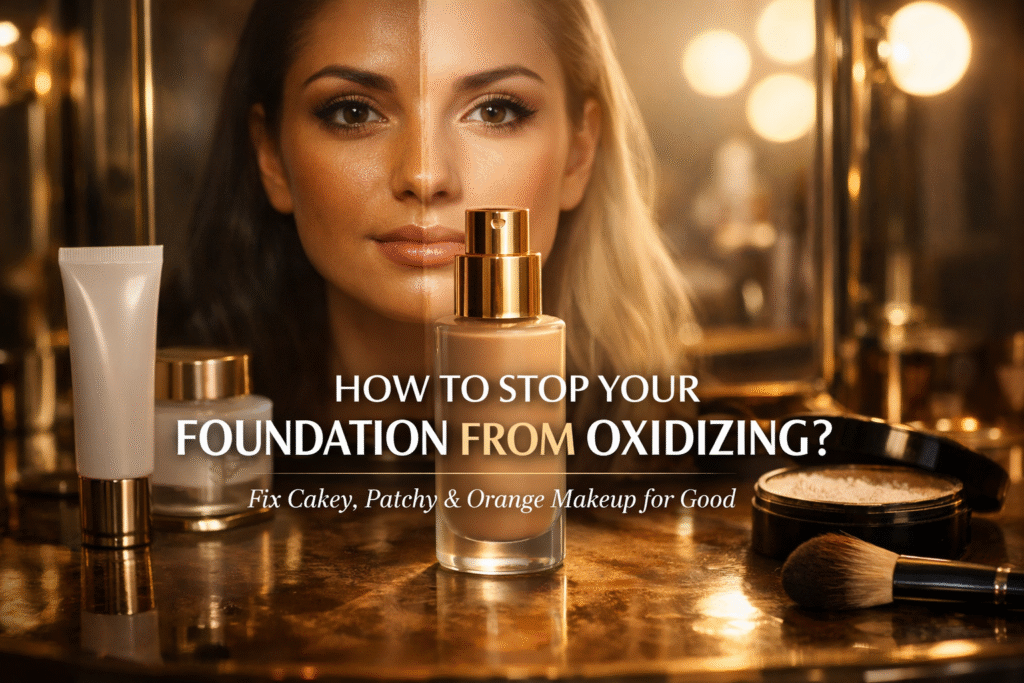
“They blamed her for everything.
Cakey. Patchy. Cracked.
They said she ruined the wedding.”
The bridal hall was glowing. Cameras flashed. Guests whispered.
And there she stood — Foundation — embarrassed and accused.
Primer stepped forward angrily:
“You never let me go first.”
Moisturizer wiped tears:
“She didn’t hydrate the bride.”
Setting Powder added softly:
“I was used too much.”
Then Foundation shouted:
“I was applied on dry, unprepped skin!”
And that’s where your answer begins.
If you truly want to learn how to stop your foundation from oxidizing, you must understand that foundation works as part of a team — not alone.
Let’s break it down step by step.
Before understanding how to stop your foundation from oxidizing, you must understand oxidation itself.
Oxidation happens when your foundation reacts with:
Air
Skin oils (sebum)
Sweat
Skincare ingredients
Your skin’s pH level
The result?
Your foundation turns darker, orange, or muddy after application.
You apply the perfect shade…
And 30 minutes later?
It looks two shades deeper.
That’s oxidation.
And it’s preventable.
If you keep asking how to stop your foundation from oxidizing, here are the most common causes:
1. Excess Oil Production
Sebum reacts with pigments and alters their color.
2. Skipping Primer
Without a barrier, foundation directly mixes with oils.
3. Overusing Moisturizer
Too much hydration can cause sliding and uneven pigment changes.
4. Wrong Formula for Your Skin Type
Dewy formulas on oily skin often oxidize faster.
5. Heavy Setting Powder
Over-powdering can cause buildup and change how foundation sets.
Foundation is reacting — not failing.
If you want real results, follow this order carefully:
Cleanse properly
Apply suitable moisturizer
Wait 3–5 minutes
Apply primer
Apply foundation in thin layers
Set lightly with powder
Simple.
But powerful.
Let’s explain why each step matters.
Moisturizer preps your skin and prevents dry patches that absorb pigment unevenly.
If skin is dry, foundation grabs onto texture.
If skin is overly greasy, foundation shifts and oxidizes.
Moisturizer Guide
| Skin Type | Best Type | Avoid |
|---|---|---|
| Oily | Oil-free gel | Thick creams |
| Dry | Rich cream | Alcohol-based formulas |
| Combination | Lightweight lotion | Heavy oils |
| Acne-prone | Non-comedogenic | Fragrance-heavy |
Let moisturizer fully absorb before moving on. This alone helps stop foundation oxidation.
If you’re serious about how to stop your foundation from oxidizing, primer is essential.
Primer:
Creates a barrier
Controls oil
Smooths texture
Improves longevity
Primer Comparison
| Primer Type | Best For | Oxidation Protection |
|---|---|---|
| Mattifying | Oily skin | High |
| Hydrating | Dry skin | Moderate |
| Silicone-based | Large pores | Strong barrier |
| Water-based | Sensitive skin | Light barrier |
Primer separates oil from pigment — and that reduces oxidation.
Foundation evens skin tone.
It does not:
❌ Hydrate deeply
❌ Fix texture
❌ Replace skincare
Foundation Guide
| Skin Type | Recommended Finish |
|---|---|
| Oily | Matte |
| Dry | Dewy or Satin |
| Combination | Natural finish |
| Acne-prone | Non-comedogenic |
Choosing the wrong finish increases oxidation risk.
Setting powder should lock makeup — not suffocate it.
Over-powdering can:
Cause heaviness
Emphasize texture
Increase color change
Use light dusting only on oily areas.
Less is more.
If you’re still wondering how to stop your foundation from oxidizing, avoid these:
Applying on dry skin
Using too much product
Ignoring undertone
Mixing incompatible skincare
Touching your face constantly
Not allowing layers to set
Small mistakes create big oxidation problems.
Here’s your quick-action checklist:
✔ Use oil-control primer
✔ Choose slightly lighter shade if prone to oxidation
✔ Blot oil before reapplying powder
✔ Avoid heavy skincare under makeup
✔ Use setting spray to melt layers
✔ Test foundation for 30 minutes before buyingTesting wear time prevents future disappointment.
| Factor | Prepped Skin | Unprepped Skin |
|---|---|---|
| Oxidation | Minimal | High |
| Longevity | 8–12 hours | 3–4 hours |
| Texture | Smooth | Patchy |
| Oil Balance | Controlled | Greasy |
| Finish | Natural | Heavy |
Prep changes everything.
To truly master how to stop your foundation from oxidizing:
Patch test new products
Check expiration dates
Store foundation away from heat
Shake bottle before use
Clean brushes regularly
Avoid layering silicone over water incorrectly
Even dirty tools can cause uneven application.
When learning how to stop your foundation from oxidizing, technique matters just as much as product choice. Professional makeup artists know that small application changes can dramatically affect how foundation wears, settles, and reacts with oil throughout the day. Below, each tip is explained in detail so you can understand not just what to do — but why it works.
✔ Press Foundation Into the Skin Instead of Dragging
One of the biggest mistakes people make is dragging foundation across the skin with a brush or sponge. Dragging creates streaks, lifts dry patches, and disturbs the skincare layer underneath. This friction can also stimulate oil production, which increases the chances of oxidation later in the day.
When you press or stipple foundation into the skin, you’re gently embedding pigment into the surface rather than moving it around. This technique:
Improves adherence
Reduces streaking
Minimizes texture emphasis
Helps foundation bond evenly
Pressing creates a smoother, more controlled layer, which reduces uneven oxidation. The more evenly foundation sits, the less likely it is to darken in patches.
✔ Use a Damp Sponge for a Natural Finish
A slightly damp makeup sponge helps control product absorption and creates a thinner, more seamless layer. When the sponge is damp (not wet), it prevents the foundation from sitting too heavily on the surface of the skin.
Heavy layers are more prone to:
Caking
Separating
Reacting with oil
Turning darker unevenly
A damp sponge gently presses product into the skin while removing excess buildup. This balanced application allows foundation to set properly without suffocating the skin — and that significantly helps if you’re trying to stop foundation oxidation.
The key is to squeeze out all excess water so the sponge is just lightly damp, not dripping.
✔ Apply Thin Layers Gradually
More foundation does not equal more coverage. In fact, thick layers are one of the fastest ways to encourage oxidation.
When foundation is applied heavily:
It mixes more intensely with oil
It traps heat on the skin
It takes longer to set
It increases the chance of separation
Instead, apply foundation in thin layers and build coverage slowly where needed. This controlled method allows each layer to settle properly before adding more.
Thin layering:
Reduces pigment concentration reacting with oil
Improves longevity
Prevents cakey texture
Keeps shade closer to original tone
Professional artists know that strategic layering beats one thick coat every time.
✔ Set Only Oily Zones
Over-powdering the entire face can create a heavy, textured finish. While powder doesn’t directly cause oxidation, excessive powder can alter how foundation sits and exaggerate color shifts.
Instead of setting everywhere, focus on oil-prone areas like:
T-zone (forehead, nose, chin)
Around nostrils
Center of the forehead
Leaving naturally dry areas lightly set or unset keeps the skin balanced and prevents buildup. Too much powder can make foundation look darker as it mixes with oil throughout the day.
Controlled powder placement maintains freshness without suffocating the base.
✔ Use Blotting Papers Before Reapplying Powder
This is a major professional secret.
When shine appears, many people immediately add more powder. But layering powder on top of oil creates buildup and can intensify oxidation.
Instead:
Use blotting papers first to absorb excess oil.
Then apply a very light touch of powder only if needed.
Blotting removes oil without disturbing foundation. This reduces the chemical reaction between oil and pigment, which is one of the main reasons foundation darkens.
This simple step alone can dramatically improve shade stability throughout the day.
✔ Use Color Corrector Before Foundation (If Needed)
If you’re layering extra foundation to cover redness, dark spots, or discoloration, you may be unintentionally increasing oxidation risk.
Thicker layers = more pigment interacting with oil.
Using a targeted color corrector first allows you to:
Neutralize discoloration
Use less foundation overall
Prevent heavy buildup
Maintain truer shade
For example:
Green corrector for redness
Peach/orange corrector for dark circles
Yellow corrector for dullness
When you reduce the amount of foundation required, you reduce the chances of oxidation and heaviness.
Why Technique Impacts Oxidation More Than You Think
Many people focus only on formulas when asking how to stop your foundation from oxidizing. But technique determines how that formula performs on your skin.
Application affects:
Oil interaction
Pigment distribution
Layer thickness
Heat retention
Longevity
Even the best foundation can oxidize if applied too heavily, dragged aggressively, or layered improperly.
But with controlled pressing, thin layering, proper blotting, and strategic powder use, you dramatically reduce the risk.
Remember:
Foundation isn’t just about what you use.
It’s about how you use it.
And mastering technique is often the missing piece between oxidation frustration and flawless wear.
Technique impacts oxidation more than you think.
Your skin’s pH affects how pigments react.
Using a gentle balancing toner after cleansing can reduce excessive oil production and stabilize foundation performance.
Small step.
Major improvement.
At Samin AI Marketing Hub, we built our entire CGI advertising framework around one core insight: why AI CGI ads are getting worse is not a technology issue—it’s a brand strategy failure. That’s why we don’t start with effects, prompts, or automation. We start with brand perception, buyer psychology, and conversion intent. Before a single CGI frame is generated, we map your beauty brand’s positioning, price point, target audience, and emotional triggers. This ensures every AI CGI ad we create reinforces trust, elevates perceived value, and supports sales—not just views.
We believe why AI CGI ads are getting worse has nothing to do with AI tools—and everything to do with missing brand intelligence. Most CGI ads fail because they start with effects instead of strategy. We reverse this completely.
Before creating any AI CGI visuals, we define:
Brand positioning (luxury, masstige, indie, or clinical beauty)
Target buyer psychology and buying triggers
Price perception and value signaling
Platform-specific ad intent (paid ads vs organic virality)
Conversion goal (trust, education, or purchase)
This strategic foundation ensures every AI CGI ad supports brand perception first, not visual chaos. By anchoring creativity to intent, we eliminate the core problem behind why AI CGI ads are getting worse and build ads that feel premium, intentional, and trustworthy to beauty consumers.
Once strategy is locked, we use AI as an enhancement layer—not a decision-maker. This is where most brands fail and why AI CGI ads lose credibility. Our process is human-directed, conversion-focused, and realism-driven.
Our AI CGI execution framework focuses on:
Studio-grade lighting to maintain luxury perception
Realistic material and texture simulation (glass, liquid, cream, shimmer)
Clear product hierarchy so the product remains the hero
Controlled motion that feels natural, not exaggerated
Camera angles designed to increase perceived product quality
Visual pacing aligned with beauty buying psychology
By blending AI speed with human creative control, we avoid the pitfalls that explain why AI CGI ads are getting worse across the industry. The result is AI CGI advertising that builds trust, supports sales, and protects long-term brand equity—especially for beauty brands targeting premium and U.S. markets.
At Samin AI Marketing Hub, we don’t chase viral visuals.
We build brand-safe AI CGI ads that convert attention into revenue.
Foundation said it best:
“I was meant to enhance — not fix everything.”
If you understand prep, layering, formula choice, and oil control, oxidation becomes manageable.
Now you know exactly how to stop your foundation from oxidizing.
And it starts before foundation even touches your skin.
If you’ve been wondering how to stop your foundation from oxidizing, the solution isn’t using more product — it’s using the right prep, formula, and technique. Oxidation happens when foundation reacts with oil, air, and improper layering, which is why primer, balanced skincare, and light setting powder make all the difference. Choose the correct formula for your skin type, allow each layer to absorb properly, and apply in thin, controlled layers. When you focus on preparation instead of blame, your foundation stays true to shade, smooth, and flawless all day.
Oxidation happens due to oil and environmental reaction.
Proper skincare prep prevents color change.
Primer acts as a protective barrier.
Choose formula based on skin type.
Use minimal powder.
Test foundation before purchase.
Ready to start creating viral, high-converting AI video ads for your brand? Join my AI Video Ads Mastery Course and learn how to create cinematic ads in minutes: no studio, no actors, no editing skills needed.
 Enroll now and transform the way you market in 2026.
Find quick answers to the most common questions about How to stop your foundation from oxidizing? Discover how this simple prep step can instantly make your foundation look flawless and give you stunning look without cracks and patches in 2026.
Foundation oxidizes when it reacts with oil, air, and skincare ingredients. Excess sebum speeds up this chemical reaction. Using oil-control primer and proper prep can significantly reduce oxidation.
Start with an oil-free moisturizer and mattifying primer. Blot oil throughout the day before reapplying powder. Choosing a matte, long-wear formula also helps control oxidation.
Yes, primer creates a barrier between your skin oils and foundation pigments. This reduces direct contact that causes color change. While it may not eliminate oxidation completely, it dramatically minimizes it.
Why does my foundation turn orange after a few hours?
This is usually due to oxidation combined with incorrect undertone selection. Oil production can darken pigments over time. Selecting the right undertone and slightly lighter shade may help.
Does moisturizer affect foundation oxidation?
Yes, heavy moisturizers can make foundation slide and react unevenly. Using the right amount and formula for your skin type is essential. Letting it absorb fully also reduces oxidation risk.
Should I choose a lighter shade to prevent oxidation?
If your foundation consistently oxidizes, choosing a slightly lighter shade can balance the darkening effect. However, proper prep should always be the first solution. Testing wear time in-store is highly recommended.
Can expired foundation oxidize more?
Yes, expired foundation formulas break down and oxidize faster. Always check expiration dates and store products properly. Old formulas may also separate and perform unevenly.
Does setting powder cause foundation to oxidize?
Using too much powder can change how foundation sets and appears heavier. While powder doesn’t directly cause oxidation, buildup can exaggerate color shifts. Light application is key.
How long should I wait between skincare and foundation?
Waiting 3–5 minutes allows skincare to absorb properly. Applying foundation too quickly can cause mixing and separation. Proper absorption reduces oxidation and patchiness.
What is the best long-term solution to stop foundation oxidation?
Focus on skin prep, oil control, and choosing the correct formula for your skin type. Use primer consistently and avoid over-layering products. Testing foundation wear time before purchasing ensures better results.