


A customer may discover an ecommerce brand through a social post, product page, or paid advertisement. In each case, the business has only a short time to explain what it offers and why the viewer should care.
A clear human-style explanation can make that message easier to understand. That is why AI spokesperson ads for ecommerce brands are becoming an option for businesses that want presenter-led video without arranging a traditional shoot for every campaign variation.
An AI spokesperson can introduce a product, explain a feature, answer a common question, or guide a viewer toward a product page. The format can be useful, but it must be created responsibly. A virtual presenter should not be presented as a real customer, a celebrity, or an expert who has personally tested a product when that is not true.
What are AI spokesperson ads?
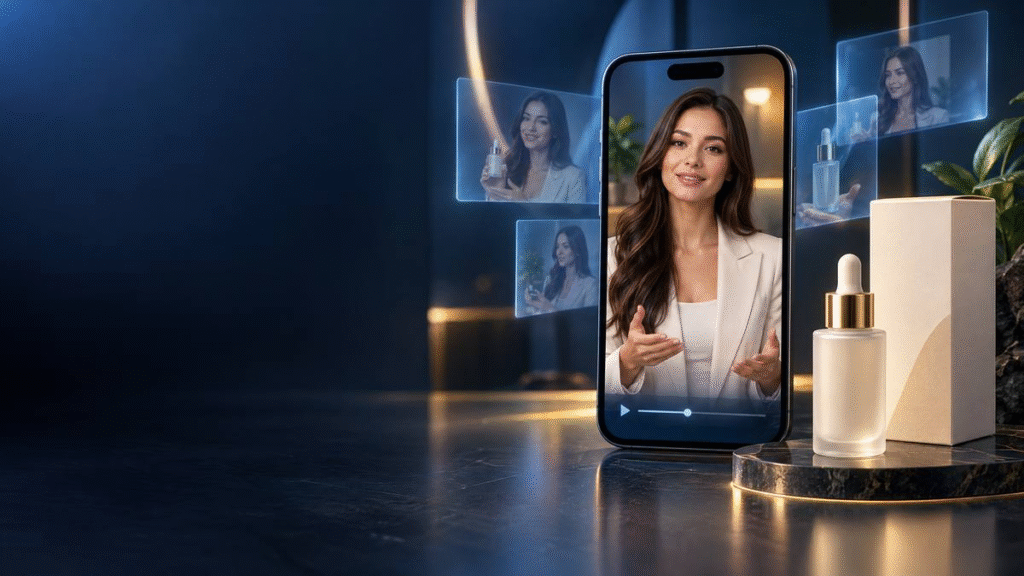
AI spokesperson ads are promotional videos that use a virtual presenter, AI-generated avatar, synthetic voice, or a combination of these elements to deliver a marketing message.
The presenter may appear in a studio-style setting, a product environment, a social-media layout, or a brand-specific visual world. The video may be a short product explanation, a campaign introduction, a demonstration, a customer-question response, or a direct call to action.
The strongest ads use the presenter to make the message clearer. The face should support the product information rather than distract from it.
Why ecommerce brands use spokesperson-led video
AI spokesperson ads for ecommerce brands can give online businesses a consistent way to explain products, answer buyer questions, and guide viewers toward a relevant product page.
Ecommerce businesses often need multiple versions of the same message. They may want different languages, audiences, offers, lengths, platforms, or product variations.
A spokesperson format can help a brand:
•Explain a product in a direct way
•Introduce a new offer or collection
•Answer a common buyer question
•Create a consistent presenter across several videos
•Adapt a script for different markets
•Add a human-style delivery to a product advertisement
•Produce short videos for social feeds and product pages
The format is not a replacement for product photography, demonstrations, reviews, or customer service. It is one communication layer within the customer journey.
When AI spokesperson ads are a good fit
An AI spokesperson ad may work well when the audience needs a clear explanation or when the brand has several messages to communicate consistently.
Consider this format when:
1.The product has features that need explanation.
2.Customers often ask similar questions before buying.
3.The campaign needs a presenter-led introduction.
4.The brand wants several language or format variations.
5.The product is supported by a clear script and approved information.
6.The campaign needs a consistent visual host.
7.The brand wants to combine a presenter with product footage or graphics.
A spokesperson may not be the best choice when the customer mainly needs to see the product in use. In that case, a UGC-style demonstration, process video, or direct product ad may communicate more naturally.
6 effective uses for an AI spokesperson ad
1. Product introduction
Use a virtual presenter to explain what the product is, who it is for, and why the audience may want to learn more.
Keep the introduction short. The product should appear clearly, and the viewer should understand the category and benefit quickly.
2. Feature explanation
A spokesperson can explain one product feature while supporting the message with close-ups, animation, screenshots, or product footage.
Choose the feature that matters most to the target customer. A short advertisement should not become a technical manual.
3. Customer-question video
Turn a common pre-purchase question into a short video. Examples might include how the product is used, what size or variant to choose, or where it fits into a routine.
This format can help the brand create useful content for social media, email, product pages, and retargeting campaigns.
4. New product or collection launch
A virtual presenter can introduce a new collection, seasonal offer, or product update. Combine the presenter’s explanation with clear product visuals and accurate availability information.
If the offer is limited or time-sensitive, check the video regularly so that outdated information does not remain in paid campaigns.
5. Educational content
Some products need context before customers understand their value. A spokesperson can explain a process, category, use case, or selection guide in accessible language.
Education works best when it answers a real customer need and avoids unsupported expert claims.
6. Call-to-action video
A concise presenter-led video can direct viewers to a product page, collection, guide, consultation, or special campaign landing page.
The destination should match the spoken message. If the presenter asks viewers to explore a particular product, make sure the link leads directly to it.
How to choose the right virtual presenter
The presenter’s appearance, voice, pace, and tone should fit the brand and the audience.
Consider:
•The age and style that suit the target customer
•Whether the presenter should feel educational, energetic, calm, or premium
•The language and accent required
•The level of formality appropriate to the product
•Whether the presenter should appear on camera or in a graphic layout
•How the presenter will remain consistent across future videos
Do not choose a presenter only because the avatar looks realistic. Trust also depends on the script, product accuracy, disclosure, delivery, and overall customer experience.
Writing a strong AI spokesperson script
A short script can follow this structure:
Opening
Start with a relevant question, customer concern, or clear product statement.
Context
Explain why the topic matters to the audience.
Product message
Introduce the product and communicate one main benefit.
Supporting evidence
Use accurate specifications, demonstrations, approved information, or a visual explanation.
Call to action
Tell the viewer what to do next.
Write for spoken delivery. Use short sentences, natural phrases, and simple transitions. A script that looks fine on a page may sound stiff when spoken aloud.
Example script framework
A general framework might be:
Looking for a simpler way to [customer goal]? [Product name] is designed for [specific use case]. It helps you [supported benefit] while fitting into [routine or situation]. See the full product details and find the option that suits you.
This is a structure, not a finished claim. Replace the placeholders with accurate product information and remove any statement the brand cannot support.
How to combine a spokesperson with product visuals
The presenter does not need to remain on screen for the entire video. Consider alternating between:
•Presenter introduction
•Product close-up
•Demonstration or usage scene
•Feature graphic
•Packaging or variant view
•Presenter call to action
This creates visual variety and keeps the product at the center of the message. If the video uses an AI-generated environment, check that the product remains accurate in every scene.
Disclosure, rights, and responsible use
Responsible use is important whenever a video includes an AI-generated person or voice.
Before publishing, confirm:
•The avatar or likeness is properly licensed.
•The voice is authorized for commercial use.
•No public figure is being imitated without permission.
•The presenter is not described as a real customer.
•The script does not invent personal experience.
•Expert, medical, financial, or technical claims are properly supported.
•Synthetic content is disclosed where required or appropriate.
•Music, images, and other assets have the correct usage rights.
A realistic presenter should not be used to create a false impression of independent endorsement. Clear, honest communication protects both the brand and the viewer.
Choosing the right platform
A spokesperson video may be adapted for social feeds, paid advertising, product pages, email, landing pages, or internal sales materials. Each placement may need a different length, aspect ratio, caption treatment, and call to action.
Before production, decide:
•Where the video will appear
•Whether it will be organic or paid content
•Which language and format are required
•Whether captions are needed
•How much of the product should appear on screen
•What action the viewer should take
•Which landing page will receive the traffic
Design for mobile first when the main placement is a vertical social platform.
What to provide to an AI video creator
A complete brief should include:
1.Product images and approved footage
2.Product name, specifications, variants, and pricing information
3.Target audience
4.Campaign objective
5.Approved benefits and claims
6.Brand voice and visual guidelines
7.Presenter style and delivery preference
8.Required language, accent, and captions
9.Intended platforms and dimensions
10.Final call to action
11.Words, claims, or scenes to avoid
12.Usage rights and delivery requirements
The creator should know which information is fixed and which parts can be explored creatively.
Common mistakes to avoid
Making the presenter the entire advertisement
The presenter should support the message, not hide the product. Use product visuals and demonstrations where they improve understanding.
Using a generic script
A broad statement about quality or innovation is less useful than a specific answer to a real customer question.
Making unsupported expert claims
Do not present an avatar as a doctor, engineer, financial adviser, or other qualified expert unless the situation is accurate, authorized, and properly supported.
Using an unauthorized likeness
A recognizable public figure, actor, influencer, or creator should not be imitated without the correct permission and license.
Ignoring the voice quality
A realistic image cannot rescue a voice that sounds unnatural, rushed, or unsuitable for the audience. Review pronunciation, pacing, emphasis, and tone.
Forgetting to update old offers
Check active campaigns regularly. Remove outdated prices, availability statements, and promotions.
How to review the finished video
Watch the video with sound and without sound. Check:
•Does the opening make sense immediately?
•Is the presenter suitable for the audience?
•Is the product shown clearly?
•Are all product details accurate?
•Does the voice sound natural and understandable?
•Are captions readable on a mobile screen?
•Are claims supported?
•Are rights and disclosures handled correctly?
•Is the call to action specific?
•Does the landing page match the video?
A professional review should include someone who understands the product and someone who represents the customer’s point of view.
How to Choose a Presenter for AI Spokesperson Ads for Ecommerce Brands
How Samin AI Marketing Hub approaches spokesperson advertising
Samin AI Marketing Hub creates AI video advertising for ecommerce brands, including AI spokesperson ads, AI UGC ads, storytelling ads, process ads, AI CGI ads, miniature ads, and short video ads.
A spokesperson-led campaign can be planned around a product explanation, customer question, launch message, educational video, or direct call to action. The visual direction should match the brand, while the script should remain focused on one useful message.
The best starting point is a brief containing approved product assets, target audience information, brand guidelines, permitted claims, preferred presenter style, platform requirements, and the desired next step.
Final thoughts
AI spokesperson ads for ecommerce brands can add a clear human-style explanation to digital campaigns. They are most useful when the presenter helps customers understand a real product benefit and guides them toward a relevant next step.
Choose a presenter and voice that fit the audience. Keep the script specific, show the product accurately, disclose synthetic elements appropriately, and review every claim before publishing.
To discuss an AI spokesperson video for your ecommerce brand, book a consultation with Samin AI Marketing Hub.
Frequently asked questions
What are AI spokesperson ads for ecommerce brands?
They are ecommerce advertisements that use an AI-generated virtual presenter, avatar, synthetic voice, or related technology to deliver a product or brand message.
Are AI spokesperson ads the same as celebrity endorsements?
No. An AI spokesperson should not imitate or imply endorsement from a celebrity, influencer, actor, or public figure without the correct permission and licensing.
Can an AI spokesperson explain product features?
Yes. A presenter can explain product features when the script uses accurate, approved information and the video makes the product easy to see and understand.
This is one of the most useful applications of AI spokesperson ads for ecommerce brands because the presenter can explain one feature while product visuals support the message.
Should AI spokesperson videos be disclosed?
Brands should follow applicable advertising rules and platform requirements. Even where a specific disclosure is not required, clear communication about synthetic presenters can help maintain audience trust.
The strongest AI spokesperson ads for ecommerce brands combine a natural presentation style with accurate product information, clear captions, and a specific call to action.
Can one spokesperson video be used on different platforms?
The main message can often be adapted, but each platform may require changes to length, aspect ratio, captions, pacing, and call to action.