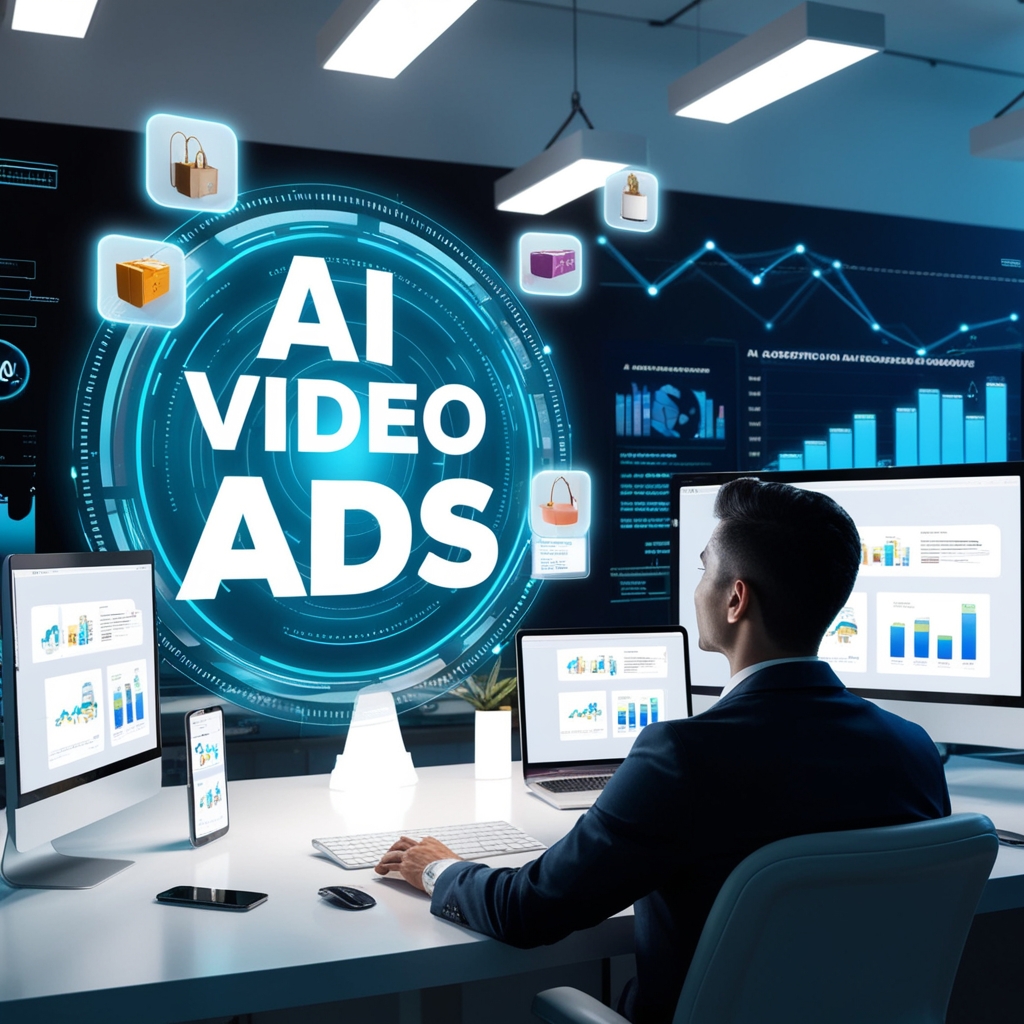




AI video ad creative is the concept and visual advertising content developed with artificial intelligence supporting selected creative or production tasks. It may include product demonstrations, UGC-style advertisements, CGI scenes, storytelling videos, spokesperson content, process ads, launch videos, and short-form social creative.
The creative can use approved product images, real footage, animation, generated environments, virtual presenters, motion graphics, captions, voiceover, or AI-assisted editing.
AI is a creative support tool rather than a replacement for marketing judgment. A strong advertisement still requires a specific audience, a clear objective, accurate product information, one important benefit, and a useful destination page.
Why AI video ad creative matters for ecommerce
Ecommerce brands often compete for attention in busy social feeds, paid placements, product pages, and retargeting campaigns. A clear video can help a shopper understand what a product does and why it may be relevant.
A focused creative concept can help a brand:
•Introduce a product quickly
•Demonstrate an important feature
•Answer a common customer question
•Build interest before a launch
•Explain a service or offer
•Create variations for different audiences
•Adapt content for several platforms
•Test different hooks and benefits
The goal is not to create the largest number of videos. The goal is to create useful creative for a specific stage of the customer journey.
7 powerful AI video ad creative ideas
1. Problem-and-solution creative
Start with a customer problem that the audience recognizes. The product then appears as a relevant solution, followed by a demonstration or explanation of the main benefit.
This structure works well when the product solves a practical issue involving time, convenience, organization, setup, comfort, selection, or routine.
Keep the problem specific. A vague statement about improving life is usually less useful than a clear situation the audience understands.
2. Product demonstration creative
Show the product performing its intended function. Use close-ups for important details and wider views when the customer needs to understand context.
A demonstration can show how to open, prepare, assemble, apply, clean, store, or use an item. It can also explain a product feature that is difficult to communicate through a still image.
For a complete demonstration approach, explore AI product demonstration videos.
3. Customer-question creative
Turn a common customer question into the opening of the advertisement. Questions from product pages, direct messages, reviews, sales conversations, and customer support can provide useful creative ideas.
Examples include:
•How does it work?
•What is included?
•Which option is right for me?
•How long does the process take?
•Is it easy to use?
•What makes this version different?
A question-led video can feel more helpful than a general promotional montage.
4. Feature-to-benefit creative
A feature matters when the customer understands what it changes. Translate a specification into a practical benefit and show the connection visually.
A material, component, or design detail may support portability, durability, convenience, accuracy, comfort, or easier use. Use approved information and avoid promising a result the product cannot reliably deliver.
5. Story-led lifestyle creative
Storytelling places the product inside a customer situation, routine, or problem-and-solution sequence. It helps the audience imagine how the offer fits into everyday life.
Keep the story short and make the product visible early enough for the viewer to understand what is being promoted.
For a story-led format, explore AI storytelling ads.
6. Process and proof creative
Process creative can show preparation, packaging, quality checks, craftsmanship, service steps, or product handling. It can help build understanding when how something is made or delivered supports the offer.
Proof may also include a demonstration, approved specification, accurate comparison, or transparent explanation. Do not invent customer experiences or present generated reconstructions as real documentary footage.
For related ideas, explore AI process ads.
7. Launch and offer creative
A new product, collection, or seasonal offer may need creative that builds anticipation, reveals the product, explains the benefit, and directs the viewer to the correct page.
Create different versions for pre-launch, launch day, and post-launch education. Each version should have a distinct purpose instead of repeating the same announcement.
For launch-focused content, see AI video ads for product launches.
How to plan AI video ad creative
Start with the campaign objective
Decide whether the advertisement is intended to build awareness, educate shoppers, generate sign-ups, support a launch, drive purchases, create bookings, or retarget previous visitors.
The objective affects the audience, message, call to action, destination page, and measurement plan. Write it in one sentence before creating the first concept.
Define the audience and buying stage
Describe the audience by need, situation, or buying stage. The audience might be a first-time visitor, a returning product viewer, an existing customer, or a shopper comparing different options.
A specific audience makes it easier to choose the language, visual setting, proof, and benefit.
Choose one central message
A short advertisement should not contain every feature, promotion, and company message. Select one important benefit and use the visual sequence to support it.
Additional benefits can become separate creative versions if they serve different audiences or campaign stages.
Create a script and scene plan
A practical structure is:
1.Relevant hook
2.Product or service introduction
3.Main benefit
4.Demonstration or proof
5.Clear call to action
For each spoken line or caption, decide what the viewer should see. The visual should support the message rather than distract from it.
For writing support, explore AI video ad scripts.
Prepare approved assets
Provide current product images, packaging references, logos, brand colors, specifications, approved claims, offer details, and existing footage. Clearly identify which details must remain exact.
Approved references help reduce changes to product shape, packaging, labels, color, materials, and proportions during production.
Choosing a creative format
UGC-style videos
UGC-style videos use a direct, conversational approach. They can explain a product or offer in a familiar social format. Do not present an AI-generated presenter as a real customer unless that is true.
Spokesperson videos
A spokesperson can answer a question, explain a benefit, introduce a product, or guide viewers to a service page. Use an authorized voice and likeness.
CGI videos
CGI can create a distinctive environment, support a product reveal, or illustrate a feature that is difficult to film. Generated scenes should preserve important product information.
Short-form videos
Short-form ads use a quick hook, one benefit, readable captions, and a direct call to action. Review them on a mobile device before publishing.
Explore AI UGC ads, AI spokesperson ads, AI CGI ads, and AI short video ads for related formats.
Creating platform-ready creative
A horizontal advertisement may not work equally well in a vertical mobile feed. Important details, captions, faces, and calls to action can be cropped or covered by platform controls.
Prepare suitable versions for vertical, square, and horizontal placements. Review duration, safe areas, captions, sound, thumbnail frames, and calls to action for each platform.
Many viewers watch with sound turned off. Use readable captions, strong contrast, and visual actions that remain understandable silently.
Product accuracy and responsible advertising
AI-generated scenes can accidentally change important product details. Compare every final version with approved source materials.
Check:
•Product shape, dimensions, color, and materials
•Packaging, labels, and logos
•Product functions and limitations
•Prices, discounts, and availability
•Shipping, returns, and booking information
•Health, safety, and performance claims
•Testimonials and customer permissions
•Presenter likeness and voice rights
•Music, footage, and visual licenses
•The relationship between the advertisement and landing page
Do not create invented reviews, false customer experiences, or unsupported endorsements. Do not show a product achieving a result it cannot reliably deliver.
If a generated visual represents a concept or reconstruction rather than real footage, describe it accurately where appropriate.
Connecting creative to the landing page
The destination page should match the promise made in the advertisement. A product video should link to the correct product or variation. A service video should link to a page that explains the offer and provides a clear enquiry or booking path.
Before launch, confirm that the page includes current information, accurate pricing, availability, useful proof, mobile-friendly design, and a visible next step.
A visually impressive advertisement cannot fix a slow, unrelated, or confusing post-click experience.
Testing AI video ad creative
Test one major creative difference at a time. Possible variations include the hook, product benefit, demonstration angle, presenter, duration, caption style, or call to action.
Keep the audience, placement, budget, and objective as consistent as possible. Record what changed and what the results suggest.
Useful measurements may include watch time, completion rate, click-through rate, product-page visits, add-to-cart actions, purchases, bookings, and qualified enquiries.
For a structured approach, explore AI video ad testing.
How Samin AI Marketing Hub supports ecommerce brands
Samin AI Marketing Hub creates AI-assisted advertising content for ecommerce brands and growing businesses. Creative options include product demonstrations, UGC-style ads, CGI campaigns, storytelling videos, process content, spokesperson videos, short-form advertisements, product launches, and testing variations.
A focused brief identifies the audience, objective, customer problem, central benefit, approved information, platform requirements, visual direction, and call to action.
Visit the Samin AI Marketing Hub Services page to explore the available support and view the portfolio for examples.
To discuss a campaign, book a consultation with Samin AI Marketing Hub.
Final thoughts
AI video ad creative helps ecommerce brands turn product information into clear and adaptable advertising content. The strongest creative begins with one audience, one problem, one benefit, one proof point, and one relevant action.
Use AI to explore and adapt ideas, but keep human review, product accuracy, responsible claims, mobile readability, and landing-page consistency at the center of the process.
Frequently asked questions
What is AI video ad creative?
It is the concept and visual advertising content developed with AI supporting tasks such as scripts, storyboards, product visuals, captions, voiceover, editing, and creative variations.
Is AI video ad creative useful for ecommerce?
Yes. It can help ecommerce brands create product demonstrations, UGC-style advertisements, launch videos, CGI, storytelling, process content, spokesperson videos, and short-form ads.
What assets are needed for AI video ad creative?
Useful assets include product images, packaging references, logos, brand guidelines, specifications, approved claims, offer details, existing footage, audience information, and the destination URL.
How can brands keep AI video creative accurate?
Use approved source materials and review every final scene for product details, packaging, functions, claims, pricing, availability, permissions, captions, and landing-page consistency.
Does AI video ad creative guarantee more sales?
No. Results also depend on the offer, audience, targeting, budget, landing page, pricing, checkout, customer experience, and testing process.