


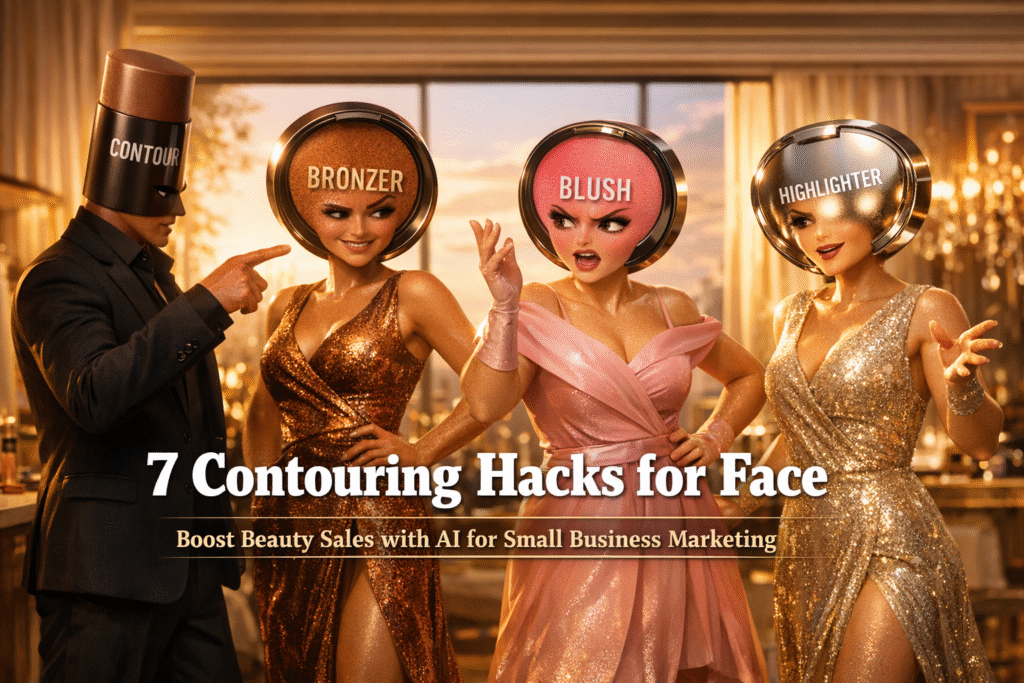
Let’s start with a scene.
“They mixed them up… and ruined the face.”
Contour stands in shock.
Bronzer laughs.
Blush gasps dramatically.
Highlighter sparkles in disbelief.
Sound familiar?
Here’s the truth…
Most customers don’t know the difference between contour, bronzer, blush, and highlighter. And when results look wrong?
They blame the brand.
But here’s the twist.
The real problem isn’t product quality.
It’s education.
And that’s where contouring hacks for face become more than beauty tips — they become sales drivers.
Keep reading… because this changes everything.
Beauty buyers today want:
Tutorials
Transparency
Transformation
Trust
And guess what builds all four?
Educational storytelling.
When you use AI for small business marketing to create cinematic, emotional, humorous ads like The Contour Conspiracy, you:
Teach correct usage
Reduce product misuse
Increase satisfaction
Lower refunds
Boost repeat purchases
This is AI for sales and marketing done right — value first, conversion second.
Let us understand the story.
“I create shadows. I sculpt.”
Educational truth:
Contour mimics natural shadow using cool tones.
Sales lesson:
Position contour as a sculpting tool — not a bronzer replacement.
“She used you all over her face!”
Educational truth:
Bronzer adds warmth, not structure.
Sales lesson:
Bundle contour + bronzer as a “Sculpt & Warm Duo” instead of selling separately.
“She put me under the cheekbone!”
Educational truth:
Blush goes on apples of cheeks.
Sales lesson:
Create placement guides in your AI storytelling ads.
“I was dragged across the whole forehead!”
Educational truth:
Highlighter belongs on high points only.
Sales lesson:
Teach precision — increase perceived luxury.
1. 🇫🇷 Fenty Beauty – “Frick ‘n’ Frack Sculpt”
A storytelling-driven campaign showing dual sculpting steps with contour and highlighter.
What Works:
Focuses on contour + highlight routine instead of single product sales.
Educational visuals show real placement and technique.
Product set is portrayed as a duo solution, increasing average cart value.
✨ What you can adapt with AI:
Create AI-generated storytelling ads illustrating contour + bronzer + blush + highlighter working together as a “team,” similar to Fenty’s duo approach — but expanded into routine education.
2. 🇺🇸 Glossier “Get That Glow” Series
A social-first storytelling ad series about everyday glow routines including highlighter and blush.
What Works:
Narrative style: step-by-step routine education.
Long-form tutorial vibes optimized for mobile viewing.
Product-focused but not pushy — it teaches first.
✨ What you can adapt with AI:
Use AI to generate similar narrative sequences — e.g., “Scene 1: Contour tells its purpose,” “Scene 2: Bronzer shows warmth,” etc. — and guide users through emotional and visual learning.
3. 🇯🇵 Shiseido – “Everyday SPF Protection”
Storytelling ad campaign connecting sunscreen to skin health routines.
What Works:
Educates on why SPF matters rather than just “buy this SPF.”
Multiple products in one narrative (SPF + moisturizer + serum).
Builds trust around science and benefits.
✨ What you can adapt with AI:
Just like Shiseido, use educational storytelling to explain why contouring works and include multiple products in one AI storytelling ad — from contour to bronzer to finish.
4. 🇺🇸 Anastasia Beverly Hills – “Contour Cream Kit Tutorial”
Highly educational product tutorial that showcases placement, blending, and finishing tips.
What Works:
Step-by-step demonstrations break down contour usage.
Multiple shade options featured for all skin tones.
Creates a conceptual system instead of a single purchase.
✨ What you can adapt with AI:
Turn this tutorial style into AI storytelling ads with emotional hooks — for example, contour interacting with bronzer and blush characters in animated sequences.
5. 🇺🇸 Hourglass Cosmetics – “Ambient Lighting Edit” Story
Storytelling around integrated products that deliver dimension and light.
What Works:
Emotional language (“light,” “dimension,” “texture”).
Products in a system, not siloed.
Driven by aesthetics + educational content.
✨ What you can adapt with AI:
Use similar narrative voice and descriptive storytelling in AI-generated ads — emphasizing how each contour product works together and why.
6. 🇬🇧 Charlotte Tilbury – “Get the Look” Walkthroughs
High-quality routine-based campaigns including contour, blush, bronzer, and highlight.
What Works:
Teaches routines visually and step-by-step.
Offers product bundles based on looks.
Empowers customers with confidence.
✨ What you can adapt with AI:
AI storytelling ads can generate predictive placement visuals — imagine contour and bronzer “advising” a customer on application technique.
Educate first, sell second
✔ Promote routines instead of single products
✔ Use storytelling (tutorial, narrative, transformation)
✔ Include multiple SKUs naturally
✔ Build authority and trust before pushing offers
…and you can elevate each of these into AI ads that:
Create multiple variations based on audience segments
Personalize messaging automatically
Deliver cinematic storytelling (emotion + instruction)
Promote group products without hard selling
Here’s a structure inspired by these real brands:
Hook with conflict or misconception (e.g., “They mixed them up…”)
Educate through narrative (Contour vs Bronzer vs Blush vs Highlighter)
Show benefits instead of features
Include product routine (system)
End with a calm, value-based CTA
Use AI to generate variations automatically
Now let’s get practical.
1. Use Cool-Toned Contour Only for Shadows
Here’s why it matters.
Warm contour = muddy face.
Cool contour under cheekbones creates dimension.
When you teach this through AI for sales and marketing, customers see better results — and attribute that success to your brand.
2. Bronzer Goes Where the Sun Naturally Hits
Temples. Upper cheeks. Forehead edges.
Not under cheekbones.
This distinction alone reduces misuse complaints.
And fewer complaints mean stronger reviews.
3. Blush Belongs on the Apples
Have your customer smile.
Apply blush on the apples, blend upward.
Pro tip: demonstrate this visually in AI ads.
Visual education converts faster than text.
4. Highlighter Only on High Points
Top of cheekbones.
Nose bridge.
Cupid’s bow.
Not everywhere.
Luxury is precision.
5. Blend with Purpose, Not Panic
Dragging product randomly creates chaos.
Press, blend upward, use light hand.
Technique affects perception of formula quality.
6. Layer Strategically
Contour → Bronzer → Blush → Highlighter.
Wrong order = confusion.
Teach order visually.
7. Use Lighting to Check Placement
Bad lighting ruins good application.
Encourage natural light checks.
And here’s the kicker…
When you teach all four products together, average order value increases.
| Product | Purpose | Placement | Tone | Common Mistake | Sales Opportunity |
|---|---|---|---|---|---|
| Contour | Create shadow | Under cheekbones, jawline | Cool | Used as bronzer | Sculpt Kit Bundle |
| Bronzer | Add warmth | Temples, cheeks | Warm | Applied as contour | Summer Glow Set |
| Blush | Add life | Apples of cheeks | Rosy/Peach | Placed too low | Flush Collection |
| Highlighter | Add light | High points | Light reflective | Over-application | Glow Precision Kit |
This table alone can become:
Instagram carousel
AI ad script
Website education page
Email sequence
That’s AI for small business marketing in action.
Let’s zoom out.
You don’t sell products.
You sell routines.
When customers learn:
Step 1: Contour
Step 2: Bronzer
Step 3: Blush
Step 4: Highlight
You just sold four items instead of one.
That’s the Routines to Revenue System.
And AI storytelling ads make it emotional instead of pushy.
Imagine this.
A 30-second AI-generated wedding scene:
Contour offended.
Bronzer laughing.
Blush dramatic.
Highlighter glowing.
The ad teaches placement humorously.
No hard selling.
But guess what?
Customers suddenly want the full set.
This is modern AI for sales and marketing:
Value-first
Emotion-driven
Education-based
Multi-product promotion
All in one ad.
Let’s be honest.
Here’s where brands go wrong:
Selling products individually without context
Not teaching usage
Using overly salesy language
Ignoring storytelling
Avoiding AI tools
In 2026, attention belongs to brands who educate.
- Avoid using one model for all skin tones without guidance.
- Avoid over-editing tutorials.
- Avoid skipping routine sequencing.
- Avoid promoting single items when the routine converts higher.
- Avoid neglecting customer education emails.
- Avoid ignoring short-form AI video content.
- Avoid treating AI as automation only — use it creatively.
- Avoid tone-deaf ads that push product without teaching.
- Avoid separating product marketing from routine education.
Create mini-series ads.
Episode 1: The Contour Conspiracy
Episode 2: The Bronzer Betrayal
Episode 3: The Blush Drama
Hook viewers emotionally.
Use AI for small business marketing to produce consistently.
Bundle products visually in storytelling.
Turn tutorials into narrative arcs.
Track engagement, not just clicks.
Instead of:
“Buy this contour.”
Say:
“Build your sculpt routine.”
This subtle shift increases cart value without feeling salesy.
That’s intelligent AI for sales and marketing psychology.
At Samin AI Marketing Hub, we built our entire advertising framework around one core insight: why AI ads are getting worse is not a technology issue—it’s a brand strategy failure. That’s why we don’t start with effects, prompts, or automation. We start with brand perception, buyer psychology, and conversion intent. Before a single video frame is generated, we map your beauty brand’s positioning, price point, target audience, and emotional triggers. This ensures every AI ad we create reinforces trust, elevates perceived value, and supports sales—not just views.
We believe why AI ads are getting worse has nothing to do with AI tools—and everything to do with missing brand intelligence. Most ads fail because they start with effects instead of strategy. We reverse this completely.
Before creating any AI visuals, we define:
Brand positioning (luxury, masstige, indie, or clinical beauty)
Target buyer psychology and buying triggers
Price perception and value signaling
Platform-specific ad intent (paid ads vs organic virality)
Conversion goal (trust, education, or purchase)
This strategic foundation ensures every AI ad supports brand perception first, not visual chaos. By anchoring creativity to intent, we eliminate the core problem behind why AI ads are getting worse and build ads that feel premium, intentional, and trustworthy to beauty consumers.
Once strategy is locked, we use AI as an enhancement layer—not a decision-maker. This is where most brands fail and why AI ads lose credibility. Our process is human-directed, conversion-focused, and realism-driven.
Our AI Ad execution framework focuses on:
Studio-grade lighting to maintain luxury perception
Realistic material and texture simulation (glass, liquid, cream, shimmer)
Clear product hierarchy so the product remains the hero
Controlled motion that feels natural, not exaggerated
Camera angles designed to increase perceived product quality
Visual pacing aligned with beauty buying psychology
By blending AI speed with human creative control, we avoid the pitfalls that explain why AI ads are getting worse across the industry. The result is AI advertising that builds trust, supports sales, and protects long-term brand equity—especially for beauty brands targeting premium and U.S. markets.
At Samin AI Marketing Hub,
We build brand-safe AI ads with a touch of virality that convert attention into revenue.
Contouring hacks for face aren’t just beauty tricks.
They are marketing assets.
They help customers succeed.
Successful customers become repeat buyers.
And repeat buyers build brands.
In 2026, brands that teach win.
Brands that only sell fade.
Stop blaming algorithms.
Stop blaming ads.
Start building education-driven AI storytelling campaigns.
Maximize sales by using expert strategies
- How AI Video ads are transforming eCommerce Marketing in 2026?
- Create AI Video Ads in seconds using CAPCUT AI Tool
- 10 Hidden ways I am using AI Video Ads to grow eCommerce Sales
- Hidden expert Strategies: AI Video Ads for eCommerce 2026
- AI Video Ads for Beauty Brands in 2026
- Why AI Video Ads dominate in 2026?
- Best Free AI Video Generator in 2026
- Make LONG AI Generated Videos FREE
- Why AI CGI Ads are getting worse and how to solve?
- 7 reasons AI Generated Ads Fail
- How to use Pixverse AI for FREE AI Video Generation
- 9 AI Ad mistakes killing FaceBook performance in 2026
- 5 Reasons why AI Generated Ads without Strategy Destroy Beauty Brands in 2026
- How to make AI Ads for Cosmetics eCommerce Brands in 2026
- How to create AI Beauty product Ad for Eyebrow Promotion
- STOP blaming your Lipstick and start using AI Storytelling Ads in 2026
- Stop blaming your Sunscreen
- 7 Contouring Hacks for Beauty Brands to boost sales in 2026
- Stop blaming your foundation and fix Ads Results using AI Storytelling Ads
- Why do my lashes keep falling out AI Ads?
- How secret skincare serum can increase sales for a brand?
- Secret skin care serum to boost sales
- How to stop your foundation from oxidizing?
- STOP blaming your foundation and start using AI Storytelling Ads in 2026
- How to sell beauthy products online in 2026 using AI Video Ads (10 Examples)
- 5 Skin care mistakes to STOP Aging
- 4 Steps Night Skin care Routine to stay young
- Eye care Routine 2026: 7 daily habits for Healthy eyes
- How to fix low sales in 2026?
- Increase sales Fast: Skincare Routine Marketing in 2026
- AI YouTube Ads to 10x Sales in 2026
- 10X Sales in 2026 using FaceBook Ads AI
- AI for Marketing: How to grow sales exponentially in 2026
Contouring hacks for face improve customer results
Better results reduce returns
Storytelling increases engagement
AI for small business marketing reduces content cost
AI for sales and marketing increases multi-product sales
Routine education boosts average order value
Emotional ads convert without pressure
Teaching builds trust
Trust builds revenue
Value scales brands
Ready to start creating viral, high-converting AI video ads for your brand? Join my AI Video Ads Mastery Course and learn how to create cinematic ads in minutes: no studio, no actors, no editing skills needed.
 Enroll now and transform the way you market in 2026.
Find quick answers to the most common questions about How Contour hacks for face can generate revenue for you? Discover how this simple editing step can instantly make your content more engaging, professional, and ready to grab attention in 2026.
Contouring hacks for face help customers use products correctly. When customers see better results, they attribute that success to your brand. This improves retention and increases repeat purchases.
AI for small business marketing allows brands to create cinematic storytelling ads at lower cost. It enables consistent educational content production that builds authority and drives engagement.
When customers understand how contour, bronzer, blush, and highlighter work together, they buy the full routine instead of one product. This increases average order value.
Can AI for sales and marketing promote multiple products in one ad?
Yes. Storytelling ads naturally include multiple products in one routine. This avoids aggressive upselling while still increasing conversions.
Why do customers confuse contour and bronzer?
Because brands often fail to clearly educate on tone differences and placement. Educational storytelling solves this confusion.
How often should brands post AI storytelling ads?
Consistency matters. Weekly educational storytelling builds familiarity and brand trust.
Are contouring hacks for face suitable for all skin tones?
Yes, but education must include shade guidance. Inclusive tutorials increase brand credibility.
Does AI for small business marketing replace creative teams?
No. It enhances creative production and speeds execution, allowing teams to focus on strategy.
What’s the biggest mistake in AI for sales and marketing?
Using AI only for automation instead of emotional storytelling. Emotion drives buying decisions.
How can beauty brands start using contouring hacks for face in marketing?
Start with a storytelling concept. Build a routine narrative. Use AI tools to produce high-quality short-form ads. Focus on value first.