


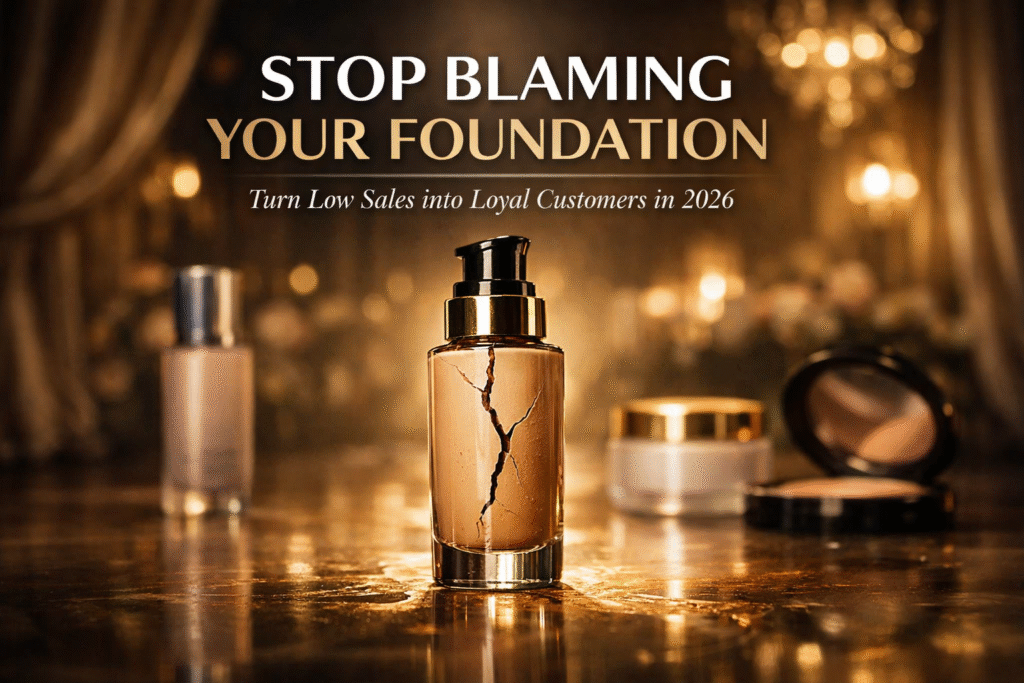
“They blamed her for everything.
Cakey. Patchy. Cracked.
They said she RUINED the wedding.”
Imagine this as your next ad.
A bridal hall.
Whispers.
A foundation bottle sitting in the middle — humiliated.
Primer steps forward:
“You never let me go first.”
Moisturizer cries:
“She ignored hydration.”
Setting Powder whispers:
“I was used too much.”
And finally, Foundation screams:
“I was applied on dry, unprepped skin!”
So, stop blaming your Foundation.
Now pause.
That story isn’t just entertaining.
It’s educational.
It reframes blame.
It builds authority.
It positions the brand as honest.
And most importantly?
It makes people stop scrolling.
If you’re a beauty product owner in 2026, this is the shift you must understand:
👉 Consumers don’t trust perfection.
👉 They trust transparency.
👉 They reward brands that teach, not just sell.
So before you blame your foundation product for declining engagement…
Let’s talk about your marketing.
Here’s the hard truth.
Most beauty brands are still posting:
Static product photos
“Shop now” captions
Influencer swatches with no education
Discount-driven hooks
And then they wonder:
Why is engagement low?
Why are returns high?
Why do customers complain about oxidation, cakiness, patchiness?
Because the customer was never taught how to use it.
And in 2026, ignorance equals refunds.
When customers don’t understand product roles, they blame the product.
When brands don’t educate, they lose trust.
So instead of saying:
“Long-lasting, full coverage foundation!”
Try this:
“Stop blaming your foundation. Here’s why it oxidizes — and how to fix it.”
See the difference?
One sells.
The other solves.
Guess which builds authority?
Let’s break this down strategically.
Storytelling works because it activates:
Emotion
Curiosity
Relatability
Memory retention
Trust
And trust is the new currency of beauty marketing.
Consumers in 2026 are:
More informed
More skeptical
More comparison-driven
More review-focused
They don’t want another “flawless finish” promise.
They want to know:
Why does foundation oxidize?
How should I prep my skin?
Am I using it wrong?
And when your brand answers those questions through story…
You stop being a seller.
You become a guide.
Let’s revisit the foundation story.
What did it do?
✔ Explained oxidation
✔ Explained moisturizer’s role
✔ Explained primer’s function
✔ Explained proper powder use
✔ Removed product blame
✔ Built brand authority
And here’s the magic:
It sold without selling.
That’s 2026 marketing.
| Traditional Beauty Ad | Storytelling Value Ad |
|---|---|
| “Full coverage, buy now.” | “Stop blaming your foundation. Here’s why it cracks.” |
| Focus on features | Focus on education + emotion |
| Discount-driven urgency | Problem-solving urgency |
| Short-term sales spike | Long-term brand trust |
| Product-centered | Customer-centered |
Which one creates repeat buyers?
Exactly.
Customers blame foundation when:
It oxidizes
It looks cakey
It separates
It looks heavy
It doesn’t last
But here’s the truth:
Most issues come from:
Wrong skin prep
Wrong layering
Overuse of powder
Incompatible skincare
Skin type mismatch
If your ads never explain this…
You create unrealistic expectations.
And unrealistic expectations destroy brand trust.
Instead, imagine your brand saying:
“Foundation evens tone. It does not hydrate. It does not fix texture.”
That honesty alone builds authority.
And authority builds premium perception.
Attention spans are shorter.
But standards are higher.
Consumers now ask:
Does this brand teach me something?
Does this brand understand real problems?
Is this brand transparent?
Are they just pushing product?
If your content answers those questions before purchase…
You reduce returns.
You increase retention.
You boost reviews.
That’s how storytelling increases sales.
Here’s the formula:
Problem + Emotion + Education + Solution + Authority = Trust
Trust = Conversions
Conversions + Retention = Growth
When your foundation ad says:
“Stop blaming your foundation. It’s reacting to oil. Here’s how to prevent oxidation.”
You position your brand as:
✔ Expert
✔ Honest
✔ Helpful
✔ Different
And differentiation wins markets.
Let’s break it into steps.
1. Hook With Emotion
“They said she ruined the wedding.”
That line alone increases watch time.
2. Introduce Conflict
Foundation is blamed.
3. Reveal Hidden Truth
Primer and moisturizer were ignored.
4. Educate
Explain proper layering.
5. Empower
Show correct routine.
6. Soft CTA
“If you think foundation was betrayed, follow for the truth about beauty.”
Notice what’s missing?
Hard selling.
And that’s why it works.
Education reduces:
Customer confusion
Misuse
Returns
Negative reviews
Education increases:
Product performance
Customer satisfaction
User confidence
Repeat purchase rate
When customers use your product correctly…
It performs better.
When it performs better…
They recommend it.
When they recommend it…
Your CAC drops.
That’s not creativity.
That’s smart strategy.
| Metric | Feature-Only Ads | Storytelling Value Ads |
|---|---|---|
| Click-through rate | Moderate | High |
| Watch time | Low | High |
| Shares | Rare | Frequent |
| Saves | Low | High |
| Brand recall | Weak | Strong |
| Trust level | Transactional | Emotional |
In 2026, saves and shares matter more than impressions.
Because saves indicate perceived value.
And value builds brand equity.
If you want to stop blaming your foundation sales performance, avoid these mistakes:
1. Overpromising Results
Perfection marketing is dying.
2. Ignoring Education
If you don’t teach, TikTok creators will.
3. Only Selling Discounts
Discount brands don’t build prestige.
4. Copying Viral Trends Without Value
Entertainment without education doesn’t retain.
5. Not Addressing Real Problems
Oxidation. Texture. Layering. Skin prep.
Solve them publicly.
Before implementing storytelling ads:
Ensure product claims are accurate
Train support teams with the same educational messaging
Align packaging instructions with ad education
Avoid blaming customers — educate instead
Use dermatologically backed information
Transparency must be consistent.
Not just content-deep.
✔ Create “Stop blaming your foundation” campaign series
✔ Turn FAQs into story scripts
✔ Address one common mistake per reel
✔ Show wrong vs right application
✔ Highlight team products (moisturizer, primer, foundation, powder)
✔ Use educational captions, not just emojis
✔ Encourage saves instead of “buy now”
The brands that teach win loyalty.
The brands that push lose attention.
Storytelling ads increase:
Average order value (customers buy prep + foundation)
Cross-sell opportunities
Lifetime value
Brand authority positioning
Organic reach
When customers understand layering:
They don’t just buy foundation.
They buy the system.
Moisturizer.
Primer.
Foundation.
Setting powder.
Education increases basket size.
Every negative review is content.
Instead of hiding:
“Foundation oxidized.”
Create:
“Why foundation oxidizes (and how to prevent it).”
Instead of defending…
Educate.
That transforms critics into believers.
At Samin AI Marketing Hub, we built our entire CGI advertising framework around one core insight: why AI CGI ads are getting worse is not a technology issue—it’s a brand strategy failure. That’s why we don’t start with effects, prompts, or automation. We start with brand perception, buyer psychology, and conversion intent. Before a single CGI frame is generated, we map your beauty brand’s positioning, price point, target audience, and emotional triggers. This ensures every AI CGI ad we create reinforces trust, elevates perceived value, and supports sales—not just views.
We believe why AI CGI ads are getting worse has nothing to do with AI tools—and everything to do with missing brand intelligence. Most CGI ads fail because they start with effects instead of strategy. We reverse this completely.
Before creating any AI CGI visuals, we define:
Brand positioning (luxury, masstige, indie, or clinical beauty)
Target buyer psychology and buying triggers
Price perception and value signaling
Platform-specific ad intent (paid ads vs organic virality)
Conversion goal (trust, education, or purchase)
This strategic foundation ensures every AI CGI ad supports brand perception first, not visual chaos. By anchoring creativity to intent, we eliminate the core problem behind why AI CGI ads are getting worse and build ads that feel premium, intentional, and trustworthy to beauty consumers.
Once strategy is locked, we use AI as an enhancement layer—not a decision-maker. This is where most brands fail and why AI CGI ads lose credibility. Our process is human-directed, conversion-focused, and realism-driven.
Our AI CGI execution framework focuses on:
Studio-grade lighting to maintain luxury perception
Realistic material and texture simulation (glass, liquid, cream, shimmer)
Clear product hierarchy so the product remains the hero
Controlled motion that feels natural, not exaggerated
Camera angles designed to increase perceived product quality
Visual pacing aligned with beauty buying psychology
By blending AI speed with human creative control, we avoid the pitfalls that explain why AI CGI ads are getting worse across the industry. The result is AI CGI advertising that builds trust, supports sales, and protects long-term brand equity—especially for beauty brands targeting premium and U.S. markets.
At Samin AI Marketing Hub, we don’t chase viral visuals.
We build brand-safe AI CGI ads that convert attention into revenue.
Foundation wasn’t the villain.
And maybe your product isn’t either.
Maybe your marketing just never told the full story.
In 2026, beauty brands that:
Teach before selling
Explain before claiming
Connect before converting
Will dominate.
So stop blaming your foundation.
Start telling its story.
Maximize sales by using expert strategies
- How AI Video ads are transforming eCommerce Marketing in 2026?
- Create AI Video Ads in seconds using CAPCUT AI Tool
- 10 Hidden ways I am using AI Video Ads to grow eCommerce Sales
- Hidden expert Strategies: AI Video Ads for eCommerce 2026
- AI Video Ads for Beauty Brands in 2026
- Why AI Video Ads dominate in 2026?
- Best Free AI Video Generator in 2026
- Make LONG AI Generated Videos FREE
- Why AI CGI Ads are getting worse and how to solve?
- 7 reasons AI Generated Ads Fail
- How to use Pixverse AI for FREE AI Video Generation
- 9 AI Ad mistakes killing FaceBook performance in 2026
- 5 Reasons why AI Generated Ads without Strategy Destroy Beauty Brands in 2026
- How to make AI Ads for Cosmetics eCommerce Brands in 2026
- How to create AI Beauty product Ad for Eyebrow Promotion
- STOP blaming your Lipstick and start using AI Storytelling Ads in 2026
- Stop blaming your Sunscreen
- 7 Contouring Hacks for Beauty Brands to boost sales in 2026
- Stop blaming your foundation and fix Ads Results using AI Storytelling Ads
- Why do my lashes keep falling out AI Ads?
- How secret skincare serum can increase sales for a brand?
- Secret skin care serum to boost sales
- How to stop your foundation from oxidizing?
- STOP blaming your foundation and start using AI Storytelling Ads in 2026
- How to sell beauthy products online in 2026 using AI Video Ads (10 Examples)
- 5 Skin care mistakes to STOP Aging
- 4 Steps Night Skin care Routine to stay young
- Eye care Routine 2026: 7 daily habits for Healthy eyes
- How to fix low sales in 2026?
- Increase sales Fast: Skincare Routine Marketing in 2026
- AI YouTube Ads to 10x Sales in 2026
- 10X Sales in 2026 using FaceBook Ads AI
- AI for Marketing: How to grow sales exponentially in 2026
Customers blame products when they lack education.
Storytelling ads increase watch time and trust.
Educational marketing reduces returns.
Transparency builds premium brand perception.
Emotion + Value = Higher conversions.
Teach layering, prep, and real use cases.
Story-driven campaigns outperform feature-only ads.
Ready to start creating viral, high-converting AI video ads for your brand? Join my AI Video Ads Mastery Course and learn how to create cinematic ads in minutes: no studio, no actors, no editing skills needed.
 Enroll now and transform the way you market in 2026.
Find quick answers to the most common questions about STOP Blaming Your Foundation in 2026 and increase sales. Discover how this simple editing step can instantly make your content more engaging, professional, and ready to grab attention in 2026.
Storytelling ads increase sales by building emotional connection and educating customers. When customers understand how to use foundation properly, they experience better results, leading to repeat purchases and positive reviews.
Yes. When customers know how to prep skin and prevent oxidation, product satisfaction increases significantly, reducing refunds and complaints.
Influencers create awareness. Storytelling builds brand authority. Combining both strategically produces stronger results.
How can I create value-driven ads for foundation products?
Address common problems like cakey makeup, oxidation, heavy powder use, and improper prep. Teach solutions clearly and emotionally.
Will storytelling ads work for small beauty brands?
Absolutely. In fact, smaller brands benefit more because storytelling differentiates them from corporate brands relying only on scale.
How do storytelling campaigns build brand trust in 2026?
Consumers trust brands that admit limitations and explain product roles honestly. Transparency increases perceived integrity.
Can educational ads increase average order value?
Yes. When customers understand layering, they buy complementary products like primer and moisturizer.
How often should beauty brands post value-based content?
At least 70% of your content should educate or solve problems. Selling content should support, not dominate.
What is the biggest mistake beauty brands make in marketing foundation?
Overpromising flawless results without teaching prep. This leads customers to blame the foundation instead of application mistakes.