


The advertising landscape is shifting faster than at any time in the last 50 years. Brands that once relied on traditional ad agencies, large production crews, expensive CGI studios, and weeks-long editing timelines are now witnessing a radical transformation. This change is driven by AI video creation tools such as Google Veo 3, Grok, Pixverse, Higgsfield, ElevenLabs, and NanoBanana, which are making premium video ads accessible to brands of all sizes.
This blog is a deep dive for eCommerce founders and beauty brand owners—the category of businesses most impacted by the transition from old-school production to hyper-fast, hyper-affordable AI ads. And that’s where the keyword Traditional Ads vs AI Ads becomes the center of the conversation.
Below, we explore the five hidden reasons AI video ads will dominate in 2026, how much money brands can save, how much time they can recover, and why this shift leads to higher revenue and more consistent conversions.
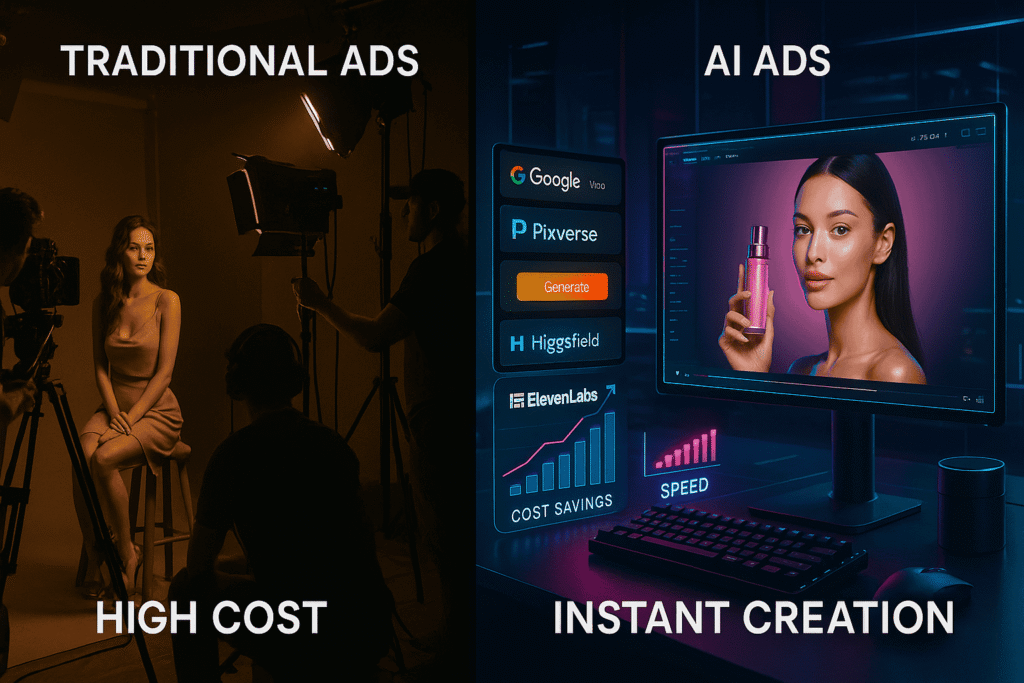
The conversation around Traditional Ads vs AI Ads has rapidly become the most important marketing discussion of 2026. For decades, traditional advertising dominated every corner of the industry — from big-budget TV commercials to polished studio shoots and glossy brand campaigns. These ads required entire production ecosystems: directors, videographers, lighting crews, stylists, makeup artists, actors, editors, voiceover artists, and post-production specialists. The process was time-consuming, rigid, and extremely expensive.
A single beauty product commercial shot in a studio could take 3–6 weeks and cost anywhere between $5,000 and $150,000 depending on the complexity. While traditional ads created memorable, high-impact campaigns, they were accessible only to brands with deep pockets and long timelines. The modern digital environment, however, has shifted dramatically. Today’s consumers scroll through content at lightning speed, judging an ad within 0.4 seconds. This requires brands especially beauty and eCommerce brands to produce more content, more variations, more often, and at a fraction of the historical cost. Traditional ads simply can’t keep up with this pace.
This is where the Traditional Ads vs AI Ads tension transformed from curiosity to necessity. The arrival of advanced AI video generation tools such as Google Veo 3, Pixverse, Higgsfield, ElevenLabs, Grok, and NanoBanana — changed the landscape completely. These tools allow brands to create cinematic product ads, model shots, macro beauty close-ups, motion-driven storytelling, and even full CGI sequences without hiring large production teams.
A process that once involved weeks of planning and thousands of dollars can now be executed in minutes by a single marketer. AI systems offer photorealistic skin textures, natural human motion, high-quality lighting simulation, studio-grade camera movement, and fully customizable environments all without physical equipment or lengthy shoots. This is not just innovation; it’s democratization. Small beauty brands that once struggled to afford professional ads can now create premium visuals on the same level as global corporations.
Mid-size eCommerce brands can release weekly ad variations instead of quarterly campaigns. And large brands can scale creative output 10x faster at significantly lower cost.
The rise of Traditional Ads vs AI Ads signals a permanent shift in how marketing content is created, optimized, and delivered. AI-generated ads allow businesses to experiment boldly, test hundreds of visual variations, hyper-personalize targeting, adjust messaging instantly, and stay on top of trends in real time.
Instead of being limited by studio availability or budget constraints, brands now operate with creative freedom and unprecedented speed.
For beauty brands in particular — where lighting, skin texture, micro-details, and aesthetic perfection matter immensely — AI video ads offer nearly flawless results at a fraction of traditional cost. With AI tools continuing to evolve at record speed, the question is no longer “will AI replace traditional ads?”
The real question is “how fast will brands abandon traditional production entirely?” As 2026 unfolds, the answer is becoming clearer every day: AI video ads aren’t just the future they are the new standard.
Consumers are consuming content faster than ever. The attention span on social media is now 0.4 seconds before a user decides whether to keep watching or scroll. Beauty brands—whose success depends on flawless visuals, emotional connection, and aesthetic excellence—must produce content that is high-quality, fast-moving, and deeply engaging.
Traditional ads simply cannot keep up:
Weeks of planning
High production costs
Specialized crews
Expensive editing and post-production
Limited ability to personalize
Slow iterations
High retainer fees for agencies
Meanwhile, AI video ads offer:
Same-day production
90% lower costs
Photorealistic models and worlds
Infinite variations for A/B testing
Instant corrections
Scalable storytelling
Access to premium visuals without professional crews
This dramatic shift is why “Traditional Ads vs AI Ads” is more than a trend — it’s the future.
Below are the five hidden, expert-level reasons AI video ads will overtake traditional ads this year.
1. AI Ads Produce 10X More Content in 1/10th the Time
Traditional ads require weeks or months of planning. AI ads? Minutes.
| Production Stage | Traditional Ads | AI Video Ads |
|---|---|---|
| Storyboarding | 2–7 days | Instant |
| Casting | 1–3 weeks | AI-generated models |
| Filming | 1–5 days | No filming needed |
| Editing | 3–10 days | Instant or same day |
| Revisions | 2–14 days | Instant |
| Total Time | 4–12 weeks | 1–48 hours |
This time reduction alone gives brands a massive advantage.
2. AI Ads Cost 70–90% Less Than Traditional Ads
This is where the “Traditional Ads vs AI Ads” debate becomes unfair.
| Type of Ad | Traditional Cost | AI Cost (Using Veo 3, Pixverse, Higgsfield, Elevenlabs, NanoBanana) |
|---|---|---|
| CGI Product Ad | $1,500–$10,000 | $150–$500 |
| UGC Style Ad | $300–$1,000 | $30–$60 |
| 3D Animation | $2,000–$15,000 | $200–$700 |
| Beauty Close-Up Macro Shot | $800–$5,000 | $50–$120 |
A CGI ad that cost $1,500 using Blender now costs $500 using AI tools — at equal or better quality.
3. AI Ads Are More Personalized and Convert Higher
AI allows brands to generate:
Different skin tones
Different lighting styles
Different age groups
Different cultural variations
Personalized product demonstrations
Unlimited A/B testing
You can test 200 versions of the same ad in one day — something impossible with traditional ads.
4. AI Ads Are More Shareable and Trend-Ready
Trends move fast. Traditional production cannot keep up. AI ads allow brands to:
Create trend-based visuals instantly
Shift color palettes
Insert trending audio with ElevenLabs
Change scenes based on season
Add holiday variations
Refresh ads every week
Beauty brands especially benefit — skin, texture, clarity, lighting, and motion can be perfected and stylized in seconds.
5. AI Ads Outperform Traditional Ads in Data-Driven Optimization
AI tools integrate with analytics engines that detect:
Best-performing facial expressions
Best color grades
Best-performing voiceover tones
Best motion styles
Best placement for text overlays
Traditional ads don’t offer this level of real-time optimization.
| Reason | Traditional Ads | AI Video Ads |
|---|---|---|
| Speed | Slow | Instant |
| Cost | High | Low |
| Flexibility | Low | High |
| Scalability | Limited | Unlimited |
| Data Optimization | Minimal | Advanced, automated |
This is why the keyword Traditional Ads vs AI Ads keeps appearing the differences are that dramatic.
| AI Tool | Main Use | Cost/Month | Why It Replaces Traditional Work |
|---|
| Google Veo 3 | Cinematic ads | $30–$80 | Replaces production crews |
| Pixverse | 3D + CGI animation | $20–$50 | Replaces CGI studios |
| Higgsfield | Realistic human motion | $25–$70 | Replaces motion capture |
| ElevenLabs | AI voiceovers | $10–$40 | Replaces voice artists |
| Grok | Scriptwriting + automation | Free–$20 | Replaces copywriters |
| NanoBanana | Beauty-focused visuals | $15–$50 | Replaces beauty studios |
| Task | Traditional Time | AI Time |
|---|
| Casting | 7–21 days | 0 days |
| Filming | 1–5 days | 0 days |
| Editing | 3–10 days | 1–60 minutes |
| Revisions | 2–5 days | Instant |
AI is cheaper, faster, and consistently better for beauty brands. Here’s what the cost difference looks like:
Budget Comparison Table
| Task | Traditional Agency | Freelancer | AI Tools (2026) | Savings |
|---|---|---|---|---|
| CGI beauty ad (Blender) | $1,500–$3,000 | $700–$1,200 | $300–$500 | 70%–85% |
| Spokesperson video | $800–$2,500 | $300–$900 | $50–$200 | 80% |
| Texture/serum animation | $600–$1,200 | $200–$400 | $20–$80 | 90% |
| Voiceover recording | $150–$500 | $80–$200 | $5–$25 | 95% |
| Editing | $400–$1,000 | $150–$400 | $10–$40 | 90% |
This is why AI Video Ads for Beauty Brands in 2026 are so cost-effective — AI tools scale without increasing budget.
Create multiple variations using different lighting styles.
Use beauty-focused tools like NanoBanana for skin perfection.
A/B test at least 10 versions per product.
Keep scenes short — 1.2 to 2 seconds per shot.
Use ElevenLabs to match voiceover tone with brand identity.
Add motion elements for better viewer retention.
Use Veo 3 for cinematic hero shots.
Produce holiday variations early.
Analyze real-time performance metrics weekly.
Refresh creatives every 7–14 days.
Overusing filters that make AI scenes look fake.
Not matching lighting with the product’s real appearance.
Using inconsistent motion styles.
Skipping voiceover quality checks.
Creating too-long scenes.
Not testing enough variations.
Using generic backgrounds.
Ignoring storytelling.
Adding too much text on screen.
Ignoring color branding guidelines.
Avoid unrealistic skin textures.
Ensure product size and scale match reality.
Maintain brand consistency across generations.
Avoid copyright or trademark look-alikes.
Always verify factual claims.
In the Traditional Ads vs AI Ads debate, 2026 marks the year when AI officially takes over. For beauty brands and eCommerce founders, AI video ads offer higher quality, lower costs, faster production, and deeper personalization than traditional methods ever could. The brands that adopt AI video creation tools now — Google Veo 3, Pixverse, Higgsfield, Grok, ElevenLabs, NanoBanana — will lead their industries, spend less money, create more content, and deliver better customer experiences.
Maximize sales by using expert strategies
- How AI Video ads are transforming eCommerce Marketing in 2026?
- Create AI Video Ads in seconds using CAPCUT AI Tool
- 10 Hidden ways I am using AI Video Ads to grow eCommerce Sales
- Hidden expert Strategies: AI Video Ads for eCommerce 2026
- AI Video Ads for Beauty Brands in 2026
- Why AI Video Ads dominate in 2026?
- Best Free AI Video Generator in 2026
- Make LONG AI Generated Videos FREE
- Why AI CGI Ads are getting worse and how to solve?
- 7 reasons AI Generated Ads Fail
- How to use Pixverse AI for FREE AI Video Generation
- 9 AI Ad mistakes killing FaceBook performance in 2026
- 5 Reasons why AI Generated Ads without Strategy Destroy Beauty Brands in 2026
- How to make AI Ads for Cosmetics eCommerce Brands in 2026
- How to create AI Beauty product Ad for Eyebrow Promotion
- STOP blaming your Lipstick and start using AI Storytelling Ads in 2026
- Stop blaming your Sunscreen
- 7 Contouring Hacks for Beauty Brands to boost sales in 2026
- Stop blaming your foundation and fix Ads Results using AI Storytelling Ads
- Why do my lashes keep falling out AI Ads?
- How secret skincare serum can increase sales for a brand?
- Secret skin care serum to boost sales
- How to stop your foundation from oxidizing?
- STOP blaming your foundation and start using AI Storytelling Ads in 2026
- How to sell beauthy products online in 2026 using AI Video Ads (10 Examples)
- 5 Skin care mistakes to STOP Aging
- 4 Steps Night Skin care Routine to stay young
- Eye care Routine 2026: 7 daily habits for Healthy eyes
- How to fix low sales in 2026?
- Increase sales Fast: Skincare Routine Marketing in 2026
- AI YouTube Ads to 10x Sales in 2026
- 10X Sales in 2026 using FaceBook Ads AI
- AI for Marketing: How to grow sales exponentially in 2026
The advertising world is shifting from manual, expensive, and slow traditional production to highly automated, personalized, and cinematic AI video ads. In 2026, tools like Google Veo 3, Pixverse, Higgsfield, NanoBanana, and ElevenLabs make it possible for beauty brands and eCommerce companies to create premium-quality ads at a fraction of the cost — and 10 times faster. The keyword Traditional Ads vs AI Ads represents a revolution in speed, efficiency, and profitability. AI ads cut production costs by up to 90%, generate visuals instantly, enable infinite A/B testing, and deliver higher conversion rates through personalization and improved storytelling. With lower budgets, short-form demands, and the rise of mobile-first attention, AI video ads are the future of high-performing, high-profit marketing.
Ready to start creating viral, high-converting AI video ads for your brand? Join my AI Video Ads Mastery Course and learn how to create cinematic ads in minutes: no studio, no actors, no editing skills needed.
 Enroll now and transform the way you market in 2026.
Find quick answers to the most common questions about Traditional Ads VS AI Ads and discover how this simple editing step can instantly make your content more engaging, professional, and ready to grab attention in 2026.
AI ads are faster, cheaper, and more personalized.
Yes — tools like NanoBanana and Veo 3 produce hyper-realistic skin, lighting, and motion.
Are AI Ads cheaper than traditional ads?
Yes, AI ADS are 90% cheaper.
Can AI replace human models?
Yes, in many cases it has replaced human models.
Is it legal to use AI Generated faces?
Yes, as long as they aren’t based on real copyrighted individuals.
What tools produce the best AI video ads in 2026?
Google Veo 3, Pixverse, Higgsfield, Grok, NanoBanana, ElevenLabs.
Do AI ads convert better than traditional ads?
In most industries, yes
Can AI ads be used for paid advertising?
Yes, Meta, TikTok, and Google all allow AI-generated content.
Will AI replace traditional production entirely?
Not fully, but it will dominate eCommerce and beauty content.
Are AI ads suitable for Beauty brands?
Yes, AI ads are perfect for Beauty Brands because they allow you to:
Test 10–20 variations quickly
Produce product demos and UGC-style videos
Create cinematic CGI visuals without expensive studios
Keep costs low while scaling testing budgets
Do I need powerful hardware or a fast computer?
No. Almost all AI video tools run in the cloud, meaning they don’t rely on your computer’s GPU or processing power. Even a basic laptop can create cinematic ads.
Can Beauty AI ads be used for TikTok, Reels, Shorts, and YouTube?
Yes. Tools like CapCut and Runway provide export formats for 9:16, 1:1, 16:9, and more. You can create one ad and instantly adapt it for multiple platforms.
Yes, as long as you use properly licensed tools. AI platforms typically grant commercial rights, meaning you can use the content in ads, campaigns, and brand promotions.
Not always — but they reduce 90% of the cost and complexity, making agencies optional instead of necessary.
Most brands now use a hybrid approach:
AI for core content
Agencies/freelancers only for advanced or large-scale projects
AI works exceptionally well for:
UGC-style ads
CGI product showcases
Story-driven ads
Founder message videos
Demonstration or tutorial-style videos
Before/after transformations
Emotional storytelling ads
What’s the biggest advantage of using AI for ads?
The biggest advantage is speed + cost reduction + unlimited creativity.
You can produce premium-quality ads at 10–20% of traditional costs while testing multiple variations instantly.