


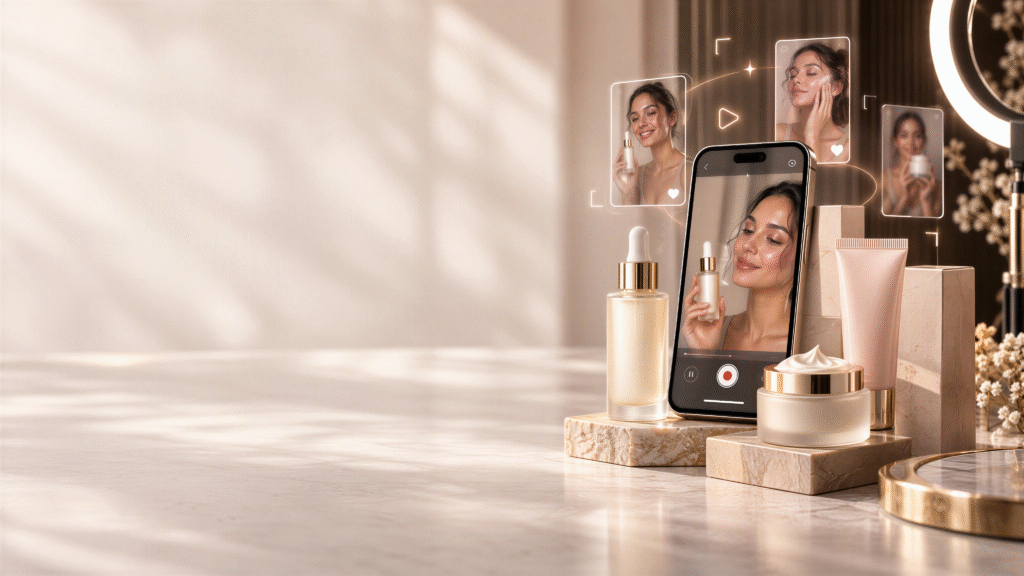
Beauty customers want more than a polished product photograph. Before buying, they often want to see how a product looks in use, how it fits into a routine, and whether the brand understands their needs.
That is why AI UGC ads for beauty brands have become an interesting option for ecommerce marketing. UGC-style content can make a product feel more familiar and easier to understand, while AI-assisted production can help a brand explore more concepts without arranging a traditional shoot for every variation.
The goal is not to make a synthetic advertisement appear to be a genuine customer review. The goal is to use the visual language of social content—direct explanations, demonstrations, routines, and problem-solving—to communicate a real product benefit clearly and responsibly.
What are AI UGC ads?
AI UGC ads are advertisements created with artificial intelligence that use the style and structure of user-generated content. They may include a virtual presenter, synthetic voice, AI-generated setting, product animation, scripted demonstration, or a combination of these elements.
A typical UGC-style beauty ad might show a product being introduced, explain who it is for, demonstrate how it is used, and finish with a clear next step. The tone is usually more conversational than a traditional brand commercial.
AI UGC is a production approach, not a substitute for honest marketing. The product details, claims, results, and customer expectations still need to be accurate.
Why beauty brands use UGC-style advertising
Beauty products are personal and visual. Customers may want to understand texture, application, routine, finish, packaging, or the problem a product is designed to address.
UGC-style video can help by:
•Showing a product in a relatable context
•Explaining how to use it
•Answering a common customer question
•Introducing a routine or product combination
•Highlighting a texture, finish, or packaging detail
•Giving the audience a person-led explanation
•Creating more creative variations for social campaigns
The best video is not necessarily the most polished one. It is the one that makes the right customer understand the product and feel confident taking the next step.
The best beauty products for AI UGC ads
AI UGC ads can be adapted to many beauty categories, including:
•Skincare products
•Haircare products
•Makeup and cosmetics
•Fragrance
•Body care
•Beauty accessories
•Nail products
•Grooming products
•Wellness and personal-care products
How AI UGC Ads for Beauty Brands Build Trust
The format is especially useful when the product benefits from a routine, demonstration, comparison, or explanation. A product that requires careful education may need a longer explainer, while a simple impulse purchase may work better with a short visual hook and a direct call to action.
Six ideas for beauty UGC-style videos
1. The simple routine demonstration
Show where the product fits into a morning, evening, travel, or pre-event routine. This gives the viewer context and helps them imagine using the product themselves.
Keep the routine realistic. Do not show impossible results or suggest that a product replaces professional advice where it does not.
2. The problem-and-solution video
Begin with a common customer concern and explain how the product is intended to help. This works best when the concern is specific and the solution can be demonstrated visually.
For example, the video might focus on simplifying a routine, preparing skin before makeup, refreshing hair, or organizing beauty products for travel.
3. The product education video
Use the video to explain how the product works, how much to use, when to use it, or which part of a routine it belongs to. Education can be more persuasive than exaggerated promises because it gives the audience useful information.
4. The texture and application video
Beauty shoppers often want to see how a product applies. A close-up can show the texture, color, finish, packaging, or application process.
If the visual is AI-generated, compare it with the real product before publishing. Shades, textures, reflections, and packaging details must be reviewed carefully.
5. The “who is it for?” video
Help the audience decide whether the product fits their needs. The script might explain the type of routine, preference, or use case the product was designed for.
This approach can qualify visitors and reduce confusion on the product page.
6. The launch or gift video
A UGC-style video can introduce a new collection, seasonal product, gift set, or limited campaign. Keep the offer, availability, and call to action accurate and current.
What makes a beauty UGC ad trustworthy?
Trust is especially important in beauty marketing because customers are making decisions about products they may apply to their body, skin, hair, or face.
A trustworthy video should:
1.Describe the product accurately.
2.Use claims the brand can support.
3.Avoid presenting an AI character as a real customer.
4.Avoid invented before-and-after results.
5.Avoid unauthorized celebrity or influencer likenesses.
6.Identify synthetic or AI-generated elements where appropriate.
7.Show the product in a way that matches what the customer will receive.
8.Use clear language instead of guaranteed outcomes.
Words such as “guaranteed,” “instant,” “cures,” or “works for everyone” should be treated carefully. The correct wording depends on the product, market, evidence, and applicable advertising rules.
A simple structure for a short beauty UGC ad
A short video can follow this structure:
Opening hook
Introduce a customer question, concern, or visual moment in the first few seconds.
Product introduction
Show the product clearly and say what it is.
Main benefit
Explain one useful benefit or use case. Avoid listing every feature.
Demonstration
Show how the product is applied, used, opened, styled, or included in a routine.
Proof or context
Use accurate product information, ingredients, specifications, or a clear explanation. Do not invent a testimonial.
Call to action
Tell the viewer what to do next, such as viewing the product, exploring the collection, or learning more.
This structure works because it gives the viewer a reason to pay attention, understand the product, and continue to the next step.
How to make AI UGC ads feel natural without misleading people
Natural does not mean deceptive. A good UGC-style ad can feel conversational while clearly remaining brand-created content.
Use a specific script instead of generic praise. Include real product details, a believable use case, and a visual that explains something. Avoid overly broad lines such as “This changed my life” unless there is a genuine, supportable reason to say them.
If a virtual presenter is used, choose an appearance, voice, and tone that suit the brand. The presenter should not imitate a real person or suggest personal experience that did not occur.
Creating variations for testing
One advantage of AI-assisted production is the ability to explore several creative directions. A brand might test:
•A question-led opening against a demonstration-led opening
•A calm educational voice against an energetic social style
•A routine video against a product-detail video
•A close-up product shot against a presenter-led introduction
•A direct call to action against a softer discovery message
Change one or two meaningful elements at a time. If everything changes between versions, it becomes difficult to understand which creative choice affected the result.
Performance should be measured using the campaign objective. A video designed for awareness may be judged by reach and completed views, while a product campaign may focus on clicks, add-to-cart activity, or purchases.
What a beauty brand should provide before production
The creator needs accurate information and approved assets. Provide:
•Clear product images and packaging photographs
•Product name, size, shade, and variant information
•Ingredient or specification details where relevant
•Approved product claims
•The intended customer
•The campaign goal
•Brand colors and visual guidelines
•Examples of content the brand likes
•Required platforms and aspect ratios
•The desired call to action
•Words, claims, and scenes to avoid
If the brand has legal, regulatory, or platform requirements, share them before the script is written.
Questions to ask an AI UGC ad creator
Before starting the project, ask:
•Is the video created with a virtual presenter, animation, or both?
•How will the product packaging and details be checked?
•What number of concepts and final versions is included?
•How many revision rounds are included?
•Are captions, voiceover, music, and sound effects included?
•What usage rights come with the final video?
•Can the video be used for paid social advertising?
•Are source files included?
•How long is the expected turnaround?
•How will AI-generated elements be disclosed?
A written scope protects both the brand and the creator. It also makes it easier to compare proposals fairly.
How Samin AI Marketing Hub supports beauty ecommerce brands
Samin AI Marketing Hub creates AI UGC ads and other AI video advertising formats for ecommerce brands. Its service range also includes storytelling ads, process ads, AI CGI ads, miniature ads, short video ads, and AI spokesperson ads.
A beauty brand can choose a format around its campaign objective. A routine demonstration may be a good fit for UGC-style content. A visually distinctive product launch may suit CGI. A brand that wants to explain its ingredients, packaging, or preparation may benefit from process-led storytelling.
The project should begin with a clear product brief, approved claims, and an understanding of the audience. From there, the creative format can be selected around what the customer needs to see and understand.
Final checklist before publishing
Before a beauty UGC ad goes live, check:
•Does the product look accurate?
•Is the main benefit clear?
•Are the captions easy to read on a phone?
•Does the video work without sound?
•Are the claims supported?
•Are results shown honestly?
•Is the presenter or voice properly licensed?
•Is any AI-generated element disclosed appropriately?
•Does the landing page match the ad?
•Is the call to action clear?
The final review should include someone who understands the product as well as someone who can assess the video from a customer’s point of view.
Conclusion
AI UGC ads for beauty brands can help ecommerce businesses create more useful and varied social content. The strongest videos do not pretend to be real customer reviews. They use a familiar social format to explain a real product, demonstrate a realistic use case, and guide the viewer toward a clear next step.
Start with the customer’s question. Choose one product benefit. Show the product accurately, use a natural script, and review every claim before publishing.
To discuss a beauty product video or AI UGC campaign, book a consultation with Samin AI Marketing Hub.
Frequently asked questions
Are AI UGC ads the same as real customer reviews?
No. AI UGC ads are brand-created advertisements that use a user-generated-content style. They should not be presented as genuine reviews or personal experiences from real customers.
Can beauty brands use AI UGC ads on TikTok and Instagram?
They can create versions for those platforms, but the brand should review current platform rules, advertising disclosures, usage rights, captions, and product-claim requirements before publishing.
What is the best length for a beauty UGC ad?
The best length depends on the platform, message, audience, and campaign objective. Keep the video long enough to explain one benefit but short enough to maintain attention.
Can AI UGC ads show product results?
They can demonstrate the product and communicate supported benefits, but brands should not invent results or use misleading before-and-after imagery. Any performance claim should be accurate and supportable.
How can a beauty brand make an AI UGC ad more original?
Use a specific customer insight, accurate product details, a distinctive brand voice, and a realistic use case. Generic praise is less useful than a clear explanation of why the product matters to a particular customer.